
Micrapate cristicauda
This record describes Micrapate cristicauda (species). Recorded family: Bostrichidae. Recorded order: Coleoptera.
Identification and Appearance
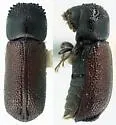
Classification
- Kingdom
- Animalia
- Phylum
- Arthropoda
- Class
- Insecta
- Order
- Coleoptera (Beetles)
- Suborder
- Polyphaga
- Superfamily
- Bostrichoidea
- Family
- Bostrichidae (Horned Powder-post Beetles)
- Subfamily
- Bostrichinae
- Tribe
- Bostrichini
- Genus
- Micrapate
Imported taxonomy record. Source availability varies; see the source references and editorial policy below.
Habitat and Range
Habitat
two of the three FL collection localities are from sandy upland areas associated with Florida scrub. (Beiriger, 2008)
Geographic Range
MD-FL (Beiriger, 2008), plus OK-TX Only five collection localities for M. cristicauda were listed in Fisher's revision of the family: Washington, District of Columbia (July 17, 1929); Chesapeake Beach, Calvert County, Maryland (September); Rosslyn, Arlington County, Virginia (June 3); Crescent City, Putnam County, Florida (no date), Manatee County, Florida (March 19, 1930). Two additional specimens were found amongst the undetermined Bostrichidae in the United States National Museum (USNM): one from Blandy Experimental Farm, University of Virginia, Clarke County, Virginia, (July 13–24, 1990); and Allen, Wicomico County, Maryland, (June 17, 1976). A single specimen was found in the Florida State Collection of Arthropods (FSCA) collected on Knotts Island, Currituck County, North Carolina (May 9, 1952). No other specimens of this species have been found in 10 other museums and three large personal collections examined. Therefore, I was greatly surprised to find a series of 21 specimens of M. cristicauda while examining bostrichid specimens in the Archbold Biological Station (ABS) collection. (Beiriger, 2008)
Seasonal Activity
Based on the label data, this species has an early spring emergence in Florida and has one generation per year. (Beiriger, 2008)
Diet and Behavior
Diet: reared in large numbers from dead grape ( Vitis ) at Washington, D.C. One specimen collected from a dead Muscadine ( Vitis rotundifolia , Vitaceae) (Beiriger, 2008)
Life History
apparently doesn't come to lights (Beiriger, 2008)
Additional species information
Species notes from the sources
Etymology: Micrapate cristicauda Casey 1898
About Primitive Winged Insects: the wider group
Order-level background for Coleoptera, the group containing Micrapate cristicauda. Species-specific details appear above.
Group overview
Coleoptera is the largest order of insects with over 400,000 described species, representing ~25% of all known animal species and ~40% of all insects. In the U.S. alone, nearly 30,000 beetle species have been identified.
Ecological role of the group
Beetles are prominent decomposers, especially in forests, breaking down dead wood and recycling nutrients. As predators, they reduce populations of pest insects. Many species are also important pollinators of flowering plants.
Economic and practical significance of the group
Beetles have major economic significance: leaf beetles (Chrysomelidae) and weevils (Curculionoidea) are among the most destructive agricultural pests globally, costing billions annually, while predatory species like ladybugs provide natural pest control.
Recorded sources for this group: Britannica, Smithsonian, NCSU Entomology. Imported estimates may describe particular regions or reporting periods.
Frequently Asked Questions About Micrapate cristicauda
How big is Micrapate cristicauda?
Length 3.64.5 mm, width 1.2-1.5 mm
Where is Micrapate cristicauda found?
| Feature | Details |
|---|---|
| Habitat | two of the three FL collection localities are from sandy upland areas associated with Florida scrub. (Beiriger, 2008) |
| Range | MD-FL (Beiriger, 2008), plus OK-TX Only five collection localities for M. cristicauda were listed in Fisher's revision of the family: Washington, District of Columbia (July 17, 1929); Chesapeake Beach, Calvert County, Maryland (September); Rosslyn, Arlington County, Virginia (June 3); Crescent City, Putnam County, Florida (no date), Manatee County, Florida (March 19, 1930). Two additional specimens were found amongst the undetermined Bostrichidae in the United States National Museum (USNM): one from Blandy Experimental Farm, University of Virginia, Clarke County, Virginia, (July 13–24, 1990); and Allen, Wicomico County, Maryland, (June 17, 1976). A single specimen was found in the Florida State Collection of Arthropods (FSCA) collected on Knotts Island, Currituck County, North Carolina (May 9, 1952). No other specimens of this species have been found in 10 other museums and three large personal collections examined. Therefore, I was greatly surprised to find a series of 21 specimens of M. cristicauda while examining bostrichid specimens in the Archbold Biological Station (ABS) collection. (Beiriger, 2008) |
What does Micrapate cristicauda eat?
The diet of the Micrapate cristicauda includes reared in large numbers from dead grape ( Vitis ) at Washington, D.C. One specimen collected from a dead Muscadine ( Vitis rotundifolia , Vitaceae) (Beiriger, 2008).
When is Micrapate cristicauda active?
Micrapate cristicauda: seasonal activity - Based on the label data, this species has an early spring emergence in Florida and has one generation per year. (Beiriger, 2008).
What is the life cycle of a Micrapate cristicauda?
apparently doesn't come to lights (Beiriger, 2008)