
Metopina
This record describes Metopina (genus). Recorded family: Phoridae. Recorded order: Diptera.
Identification and Appearance
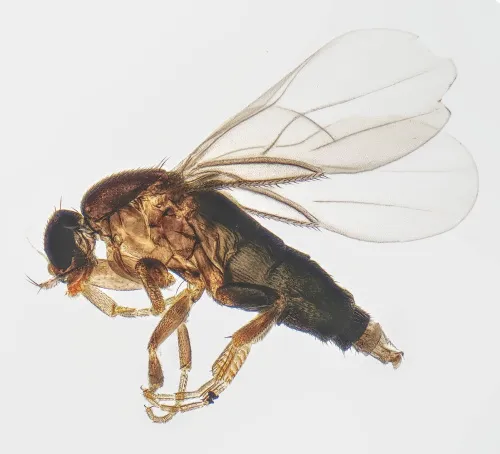
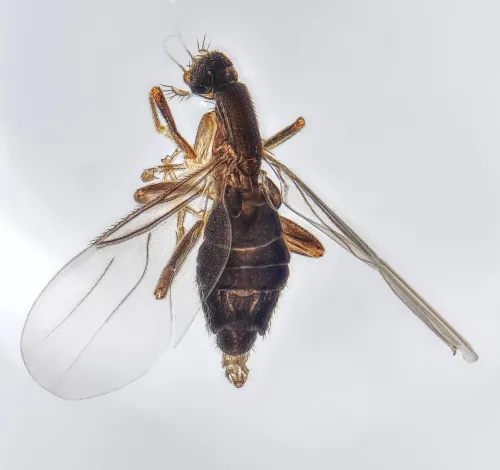
Length 1-2mm. High, rounded thorax that gives them a distinct humpbacked silhouette. Characteristic wing venation - heavy, shortened costa and radial veins clustered along the front base of the wing, with faint, thin veins running unbranched across the rest of the membrane. The frons (front of the head) features a set of supra-antennal bristles; the arrangement of fronto-orbital and interfrontal bristles helps distinguish Metopina from closely related genera like Megaselia. Unless identified by a recognised expert, a photo is required and the specimen should be examined with a microscope. In the comments box, state the key or ID method used and describe the size and identifying characters. Adults frequently visit flowers (e.g., Taraxacum, Ranunculus) for nectar and pollen, acting as minor pollinators. Adults are also attracted to buried organic matter or carrion. Larvae feed on decaying plant material, soil fungi, dead insects, and animal remains, contributing to nutrient cycling. No additional images available for this species.
Classification
Diet and Behavior
Life History
Adults frequently visit flowers (e.g., Taraxacum, Ranunculus) for nectar and pollen, acting as minor pollinators. Adults are also attracted to buried organic matter or carrion. Larvae feed on decaying plant material, soil fungi, dead insects, and animal remains, contributing to nutrient cycling.
Additional species information
Recorded status
Common and widespread.
About Flies: the wider group
Order-level background for Diptera, the group containing Metopina. Species-specific details appear above.
Group overview
Diptera includes over 150,000 described species of flies, mosquitoes, and midges. Mosquitoes are the deadliest animal on Earth (CDC). Malaria alone causes ~249 million cases and over 608,000 deaths annually, mostly children under 5 (WHO). Vector-borne diseases account for over 17% of all infectious diseases, causing 700,000+ deaths per year.
Ecological role of the group
Despite their disease impact, flies are critical decomposers and pollinators. Hoverflies alone pollinate hundreds of crop and wildflower species. Flies are also the primary food source for many birds, bats, and fish. Forensic entomology relies heavily on fly species for crime scene analysis.
Economic and practical significance of the group
In the U.S., vector-borne disease cases tripled between 2004-2016, with over 640,000 cases reported in that period (CDC). Tickborne diseases doubled from 22,000 to 48,000 annual reports. Globally, mosquito-borne diseases cost billions in healthcare and lost productivity.
Recorded sources for this group: WHO, CDC, PNAS. Imported estimates may describe particular regions or reporting periods.
Photos of Metopina (2)
Frequently Asked Questions About Metopina
What is Metopina?
Metopina is a genus in the family Phoridae, within the order Diptera.
How big is Metopina?
1-2mm. High, rounded thorax that gives them a distinct humpbacked silhouette. Characteristic wing venation - heavy, shortened costa and radial veins clustered along the front base of the wing, with faint, thin veins running unbranched across the rest of the membrane. The frons (front of the head) features a set of supra-antennal bristles; the arrangement of fronto-orbital and interfrontal bristles helps distinguish Metopina from closely related genera like Megaselia.
What is the life cycle of a Metopina?
Adults frequently visit flowers (e.g., Taraxacum, Ranunculus) for nectar and pollen, acting as minor pollinators. Adults are also attracted to buried organic matter or carrion. Larvae feed on decaying plant material, soil fungi, dead insects, and animal remains, contributing to nutrient cycling.