
Malthinus seriepunctatus
This record describes Malthinus seriepunctatus (species). Recorded family: Cantharidae. Recorded order: Coleoptera.
Identification and Appearance
| Feature | Description |
|---|---|
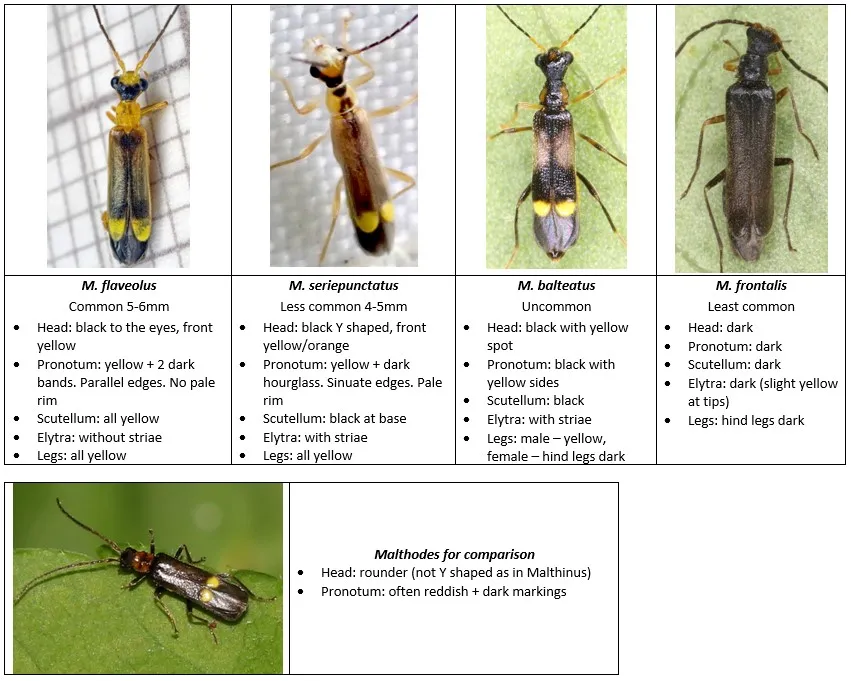
| Additional details | 4-5mm. The greyish brown elytra bear a pair of yellow spots. Scutellum black at base next to the pronotum, with yellow at the apex (tip) but it is often hard to see much yellow. |
| Pronotum | Pronotum yellow with an hour glass shaped dark mark along the length. Sometimes the middle of this can be so narrow as to leave dark marks just at the front and back. When viewed from above the rear third/half of the sides of the pronotum are slightly bowed outwards or parallel and then sharply angle inwards towards the front. There is usually a thin light rim to the pronotum, that is normally very clearly visible and distinctive, especially near the scutellum and head. Black on the head is Y shaped with yellow and orange in the middle (the black is mainly around the edge of the head hindwards from the eyes). |
| Elytra | Elytra punctured in distinct rows along the length. |
| Legs | Legs yellow. There are four UK species in the genus but these can generally be separated with care. M. flaveolus is the most similar but is larger than M. seriepunctatus . Malthodes species are often confused with Malthinus species but one general way of distinguishing is that Malthinus have Y shaped heads and the head of Malthodes are much more rounded. Your specimen should have these features: May be found on trees and bushes or visiting various flowers including umbellifers and thistles. It is also occasionally attracted to light. A summer species most likely to be encountered between May and August. Widespread in the southern half of Britain, less well recorded further north. No additional images available for this species. |
Classification
- Kingdom
- Animalia
- Phylum
- Arthropoda
- Class
- Insecta
- Order
- Coleoptera
- Family
- Cantharidae
- Genus
- Malthinus
Imported taxonomy record. Source availability varies; see the source references and editorial policy below.
Habitat and Range
Habitat
May be found on trees and bushes or visiting various flowers including umbellifers and thistles. It is also occasionally attracted to light.
Seasonal Activity
A summer species most likely to be encountered between May and August.
Additional species information
Recorded status
Widespread in the southern half of Britain, less well recorded further north.
About Primitive Winged Insects: the wider group
Order-level background for Coleoptera, the group containing Malthinus seriepunctatus. Species-specific details appear above.
Group overview
Coleoptera is the largest order of insects with over 400,000 described species, representing ~25% of all known animal species and ~40% of all insects. In the U.S. alone, nearly 30,000 beetle species have been identified.
Ecological role of the group
Beetles are prominent decomposers, especially in forests, breaking down dead wood and recycling nutrients. As predators, they reduce populations of pest insects. Many species are also important pollinators of flowering plants.
Economic and practical significance of the group
Beetles have major economic significance: leaf beetles (Chrysomelidae) and weevils (Curculionoidea) are among the most destructive agricultural pests globally, costing billions annually, while predatory species like ladybugs provide natural pest control.
Recorded sources for this group: Britannica, Smithsonian, NCSU Entomology. Imported estimates may describe particular regions or reporting periods.
Frequently Asked Questions About Malthinus seriepunctatus
What is Malthinus seriepunctatus?
Malthinus seriepunctatus is a species in the family Cantharidae, within the order Coleoptera.
Where is Malthinus seriepunctatus found?
Habitat: May be found on trees and bushes or visiting various flowers including umbellifers and thistles. It is also occasionally attracted to light.
When is Malthinus seriepunctatus active?
Malthinus seriepunctatus: seasonal activity - A summer species most likely to be encountered between May and August..