
Neon Skimmer
Libellula croceipennis
This record describes Libellula croceipennis (species). Recorded family: Libellulidae. Recorded order: Odonata.
Identification and Appearance
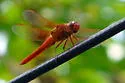
Similar to Flame Skimmer, but thorax and abdomen bright red, wings not as broadly amber/brown streaked. (Amber wash on wings does not extend beyond the nodus) L. saturata - Flame skimmer: males bright orange with amber color in the wings covering half the width of the wing, out to the nodus, and all the way to the rear of the hind wing. Females paler but still with some amber at least on the leading edge of the wing. See and females L. croceipennis - Neon Skimmer: males bright red with amber wing color only covering a quarter of the wing, halfway to the nodus, and not all the way back to the rear edge of the hind wing. Female paler and with essentially clear wings. See and female Compared to other red dragonflies in the area, male Neon Skimmers are larger and glow in the sun...they are aptly named Neon. The females are golden-colored in sunlight, especially when laying eggs, but may look duller tan on cloudy days or in shade. Very strong flyers, relatively bold and easy to photograph.
Classification
- Kingdom
- Animalia
- Phylum
- Arthropoda
- Class
- Insecta
- Order
- Odonata (Dragonflies and Damselflies)
- Suborder
- Anisoptera
- Family
- Libellulidae (Skimmers)
- Genus
- Libellula
Imported taxonomy record. Source availability varies; see the source references and editorial policy below.
Habitat and Range
Habitat
Slow streams, ponds. Neon Skimmers prefer shaded moving water when there's a choice of sites, but males will defend ponds as well. Males are typically found near water, defending territory vigorously early in the season, and perching more often later. Females appear at water to lay eggs. Perching sites for males include bushes, trees (both overhanging water, and near water), and strong emergent vegetation; perching height is usually one to five feet above water, most commonly 1-3 feet. They will perch on horizontal, slanted, or vertical twigs/branches/stems.
Geographic Range
sw US: CA-LA, OK (BG data) - see partial range map
Seasonal Activity
April-November
Diet and Behavior
Life History
Females lay eggs in standing or slow-moving water by dipping the tip of the abdomen and "scooping" drops of water, with eggs, onto algal mats or emergent or streamside vegetation. Females are not clasped by males during egglaying, which typically takes place in midday (late morning through early afternoon.)
Additional species information
Species notes from the sources
Etymology: Libellula croceipennis Selys 1868
About Dragonflies and Damselflies: the wider group
Order-level background for Odonata, the group containing Libellula croceipennis. Species-specific details appear above.
Group overview
Odonata includes ~6,000 described species of dragonflies and damselflies. Dragonflies are among the fastest flying insects, reaching 36 mph (58 km/h). They can fly in any direction including backward, and hover in place - each wing operates independently.
Ecological role of the group
Dragonflies predate dinosaurs by nearly 100 million years - fossils date to 325 million years ago. The largest dragonfly ancestor, Meganeuropsis permiana (285 mya), had a 75cm wingspan, enabled by atmospheric oxygen levels of 31-35% compared to today's 21%. Dragonflies have a 95% hunting success rate - the highest of any predator.
Economic and practical significance of the group
Dragonflies are voracious predators that consume hundreds of mosquitoes daily, providing natural pest control worth millions in reduced mosquito-borne disease risk. A single dragonfly can eat 30 to hundreds of mosquitoes per day.
Recorded sources for this group: Natural History Museum London, Britannica, fossil record research. Imported estimates may describe particular regions or reporting periods.
Photos of Neon Skimmer (5)
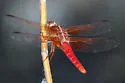
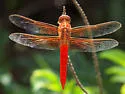
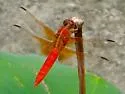
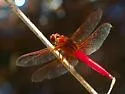
Photo credits: Contributed by Cotinis; Additional contributions by john and jane balaban , Hartmut Wisch , E Moon , Mike Quinn
Frequently Asked Questions About Neon Skimmer
What is Neon Skimmer?
Neon Skimmer (Libellula croceipennis) is a species in the family Libellulidae, within the order Odonata.
How big is Neon Skimmer?
Length 54-59 mm
How do you identify Neon Skimmer?
Similar to Flame Skimmer, but thorax and abdomen bright red, wings not as broadly amber/brown streaked. (Amber wash on wings does not extend beyond the nodus) L. saturata - Flame skimmer: males bright orange with amber color in the wings covering half the width of the wing, out to the nodus, and all the way to the rear of the hind wing. Females paler but still with some amber at least on the leading edge of the wing. See and females L. croceipennis - Neon Skimmer: males bright red with amber wing color only covering a quarter of the wing, halfway to the nodus, and not all the way back to the rear edge of the hind wing. Female paler and with essentially clear wings. See and female
Where is Neon Skimmer found?
| Feature | Details |
|---|---|
| Habitat | Slow streams, ponds. Neon Skimmers prefer shaded moving water when there's a choice of sites, but males will defend ponds as well. Males are typically found near water, defending territory vigorously early in the season, and perching more often later. Females appear at water to lay eggs. Perching sites for males include bushes, trees (both overhanging water, and near water), and strong emergent vegetation; perching height is usually one to five feet above water, most commonly 1-3 feet. They will perch on horizontal, slanted, or vertical twigs/branches/stems. |
| Range | sw US: CA-LA, OK (BG data) - see partial range map |
When is Neon Skimmer active?
Neon Skimmer: seasonal activity - April-November.
What is the life cycle of a Neon Skimmer?
Females lay eggs in standing or slow-moving water by dipping the tip of the abdomen and scooping drops of water, with eggs, onto algal mats or emergent or streamside vegetation. Females are not clasped by males during egglaying, which typically takes place in midday (late morning through early afternoon.)