
Ivy Bee
Colletes hederae
This record describes Colletes hederae (species). Recorded family: Colletidae. Recorded order: Hymenoptera.
Identification and Appearance
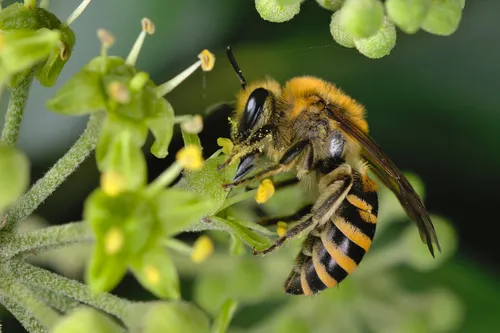
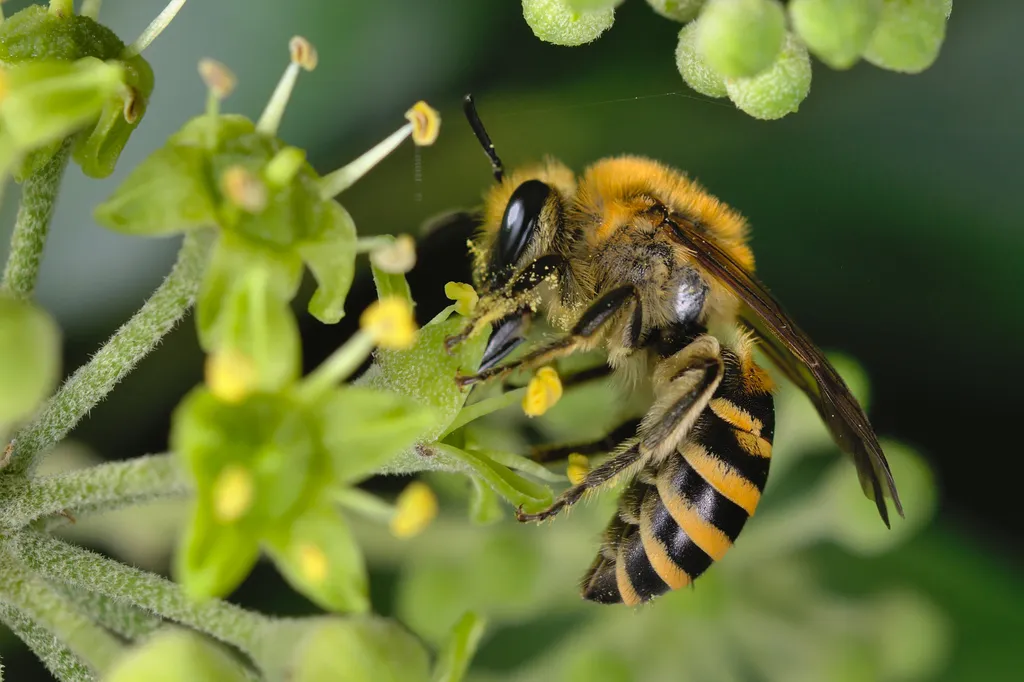
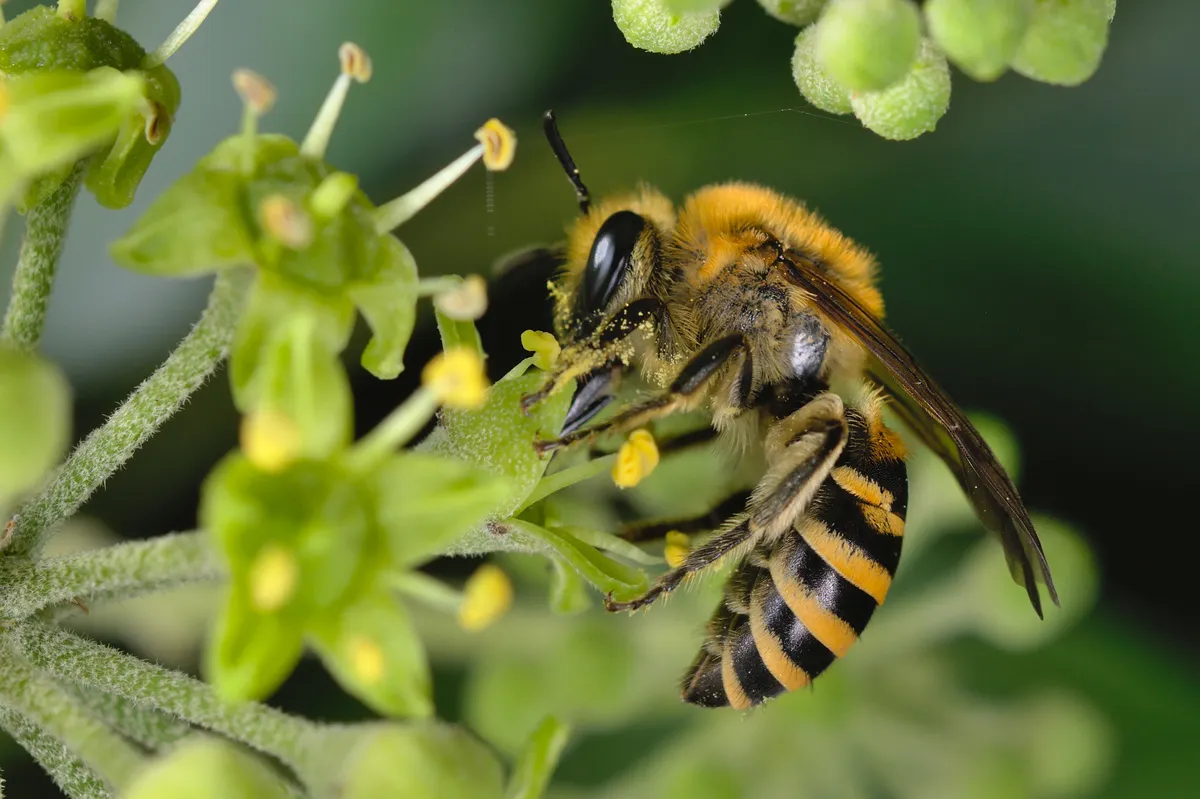
The largest of the UK banded Colletes species. The forewing of the female measures 9.5-10mm, the male 8-8.5mm. The broad buff-coloured bands and orange thorax of a freshly emerged female are distinctive, though care needs to be taken with males or faded specimens. The Ivy Bee nests in loose soil, favouring sparsely vegetated south-facing banks. Nesting aggregations can be huge in suitable locations with thousands of nests. Pollen is collected almost exclusively from Ivy which must be available near to the nest sites. This species has a single flight period from early September to the start of November. The males emerge first. This species was only described as new to science in 1993 and first recorded in the UK in 2001. It is now widespread along most of the south coast, south Wales and East Anglia, and extending its range steadily northwards. This species was first found in VC55 on 03 Oct 2017 and has expanded its range considerably since then.
Wikipedia reference for Colletes hederae: http://en.wikipedia.org/wiki/Colletes_hederae.
Classification
- Kingdom
- Animalia
- Phylum
- Arthropoda
- Class
- Insecta
- Order
- Hymenoptera
- Family
- Colletidae
- Genus
- Colletes
Imported taxonomy record. Source availability varies; see the source references and editorial policy below.
Habitat and Range
Habitat
The Ivy Bee nests in loose soil, favouring sparsely vegetated south-facing banks. Nesting aggregations can be huge in suitable locations with thousands of nests. Pollen is collected almost exclusively from Ivy which must be available near to the nest sites.
Seasonal Activity
This species has a single flight period from early September to the start of November. The males emerge first.
Additional species information
Recorded status
This species was only described as new to science in 1993 and first recorded in the UK in 2001. It is now widespread along most of the south coast, south Wales and East Anglia, and extending its range steadily northwards.
About Flies: the wider group
Order-level background for Hymenoptera, the group containing Colletes hederae. Species-specific details appear above.
Group overview
Hymenoptera includes over 150,000 described species of ants, bees, wasps, and sawflies. Earth harbors approximately 20 quadrillion (20×10^15) ants, with a combined biomass of ~12 megatons of dry carbon - exceeding the combined biomass of all wild birds and mammals (PNAS, 2022).
Ecological role of the group
About 35% of the world's food crops depend on animal pollinators. The chocolate industry, valued at over $100 billion, depends on pollinating flies and midges. Ants are the dominant soil engineers in most terrestrial ecosystems, turning more soil than earthworms in many habitats.
Economic and practical significance of the group
Pollinators contribute $235-577 billion worth of annual global food production (FAO). In the U.S., bee pollination alone benefits crops valued at $18 billion annually, and honey bees are responsible for $5.4 billion in agricultural productivity. Between April 2023-2024, 55.1% of managed honey bee colonies were lost. The U.S. bee population dropped from 5 million to 2.5 million.
Recorded sources for this group: FAO, USDA, EPA, PNAS (2022), US Fish & Wildlife Service. Imported estimates may describe particular regions or reporting periods.
Photos of Ivy Bee (3)
Frequently Asked Questions About Ivy Bee
What is Ivy Bee?
Ivy Bee (Colletes hederae) is a species in the family Colletidae, within the order Hymenoptera.
Where is Ivy Bee found?
Habitat: The Ivy Bee nests in loose soil, favouring sparsely vegetated south-facing banks. Nesting aggregations can be huge in suitable locations with thousands of nests. Pollen is collected almost exclusively from Ivy which must be available near to the nest sites.
When is Ivy Bee active?
Ivy Bee: seasonal activity - This species has a single flight period from early September to the start of November. The males emerge first..