
Exclamation Moth - Hodges#1421
Homaledra heptathalama
This record describes Homaledra heptathalama (species). Recorded family: Pterolonchidae. Recorded order: Lepidoptera.
Identification and Appearance
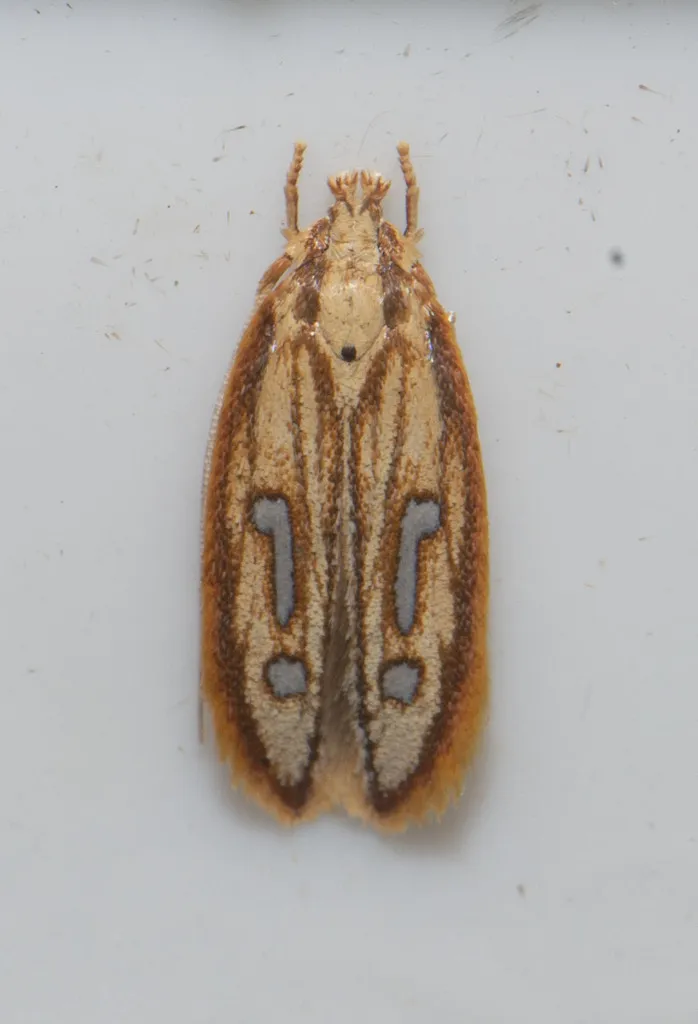
Adult - forewing slender, almost parallel-sided for most of length, tapering to a rounded point at apex; pale yellowish-brown except for darker brownish-orange strip along costa, and two white markings in median area that together resemble an exclamation point; hindwing consists of a rod-like or spike-like midrib; all wings with long fringe of hair-like scales, very prominent in spread specimens, but hidden beneath forewings (which are hugged close to the body) in live individuals at rest; antennae thick, almost as long as forewing.
Wikipedia reference for Homaledra heptathalama: http://en.wikipedia.org/wiki/Homaledra_heptathalama.
Classification
- Kingdom
- Animalia
- Phylum
- Arthropoda
- Class
- Insecta
- Order
- Lepidoptera (Butterflies and Moths)
- Superfamily
- Gelechioidea
- Family
- Pterolonchidae
- Genus
- Homaledra
Imported taxonomy record. Source availability varies; see the source references and editorial policy below.
Habitat and Range
Geographic Range
South Carolina to Florida, west to Louisiana.
Seasonal Activity
Adults present from March to October in Florida.
Diet and Behavior
Diet: Larvae feed on leaves of cabbage palmetto ( Sabal palmetto ).
Life History
See Busck (1900) below.
Additional species information
Species notes from the sources
Etymology: Exclamation Moth was coined by Bob Patterson here , referring to the wing markings that look like an exclamation mark: " ! " heptathalama is from Greek hepta (επτα)- "seven" + thalamos (θαλαμος)- "inner room or chamber" From the original description: "It feeds on the underside of the palmetto leaf in a fold, making a very unique chambered abode of its frass (or of the chewed epidermis) (Plate I, fig. 1). It begins by making a small elongate chamber and adds, as it grows, successively larger, more or less rectangular, thick-walled, communicating rooms to its house, the entire length of which is l 1/2 to 2 inches, and which when finished contains 7 (or sometimes 8) chambers; hence the name of the insect."
About Butterflies and Moths: the wider group
Order-level background for Lepidoptera, the group containing Homaledra heptathalama. Species-specific details appear above.
Group overview
Lepidoptera includes approximately 180,000 described species of butterflies and moths. Moths outnumber butterflies roughly 10:1. The monarch butterfly's eastern population has declined by more than 80% since the mid-1990s, and the western population by over 95% since the 1980s. The IUCN lists the migratory monarch as Vulnerable.
Ecological role of the group
Butterflies and moths are essential indicators of ecosystem health. As caterpillars, they are a primary food source for birds - a single nest of blue tit chicks requires ~10,000 caterpillars. Adult moths pollinate many night-blooming plants.
Economic and practical significance of the group
Lepidoptera are critical pollinators. In Europe, grassland butterfly species have declined by almost 50% since the early 1990s. In the UK, three-quarters of butterflies are in decline. In the U.S., five butterfly species have gone extinct since 1950, with 29 listed as endangered.
Recorded sources for this group: IUCN Red List, Xerces Society, USFWS, PNAS, WWF. Imported estimates may describe particular regions or reporting periods.
Photos of Exclamation Moth - Hodges#1421 (3)
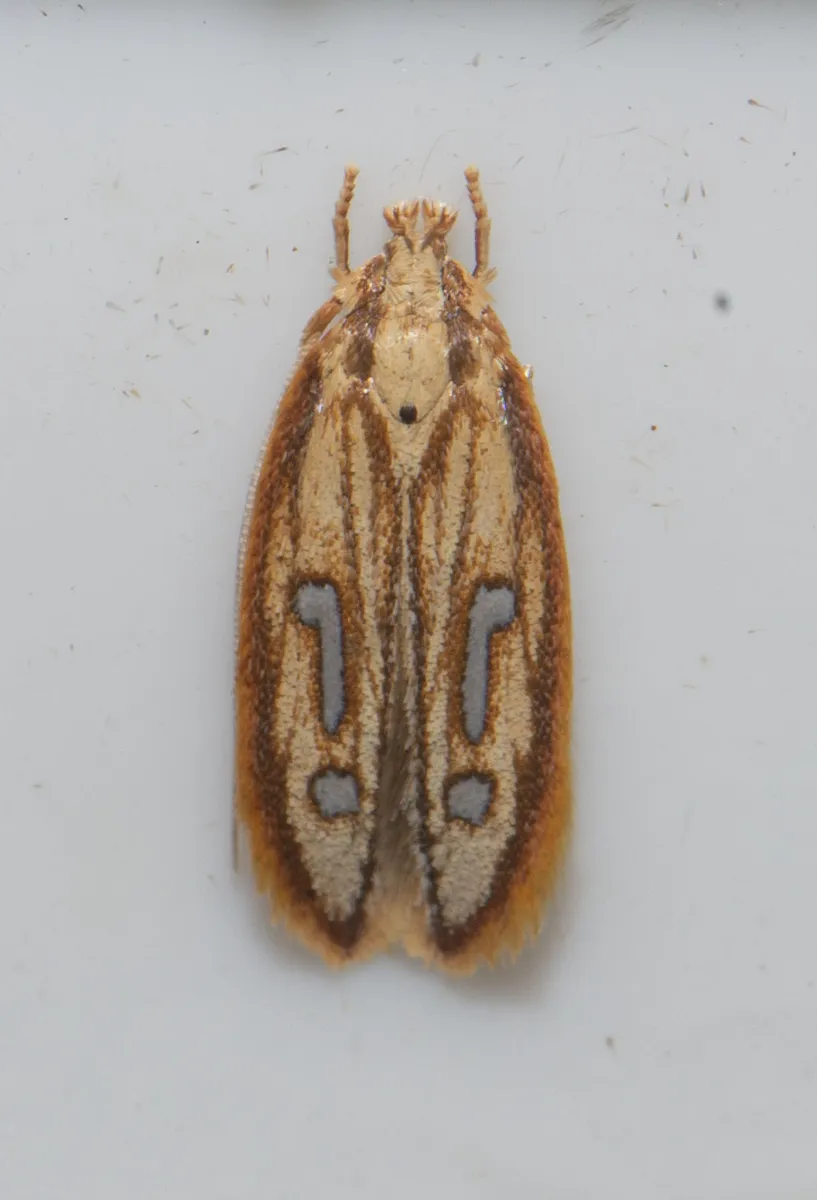
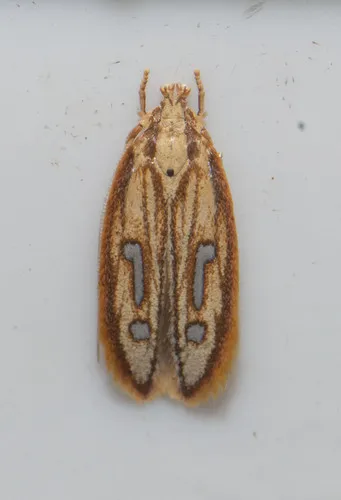
Photo credits: Contributed by Robin McLeod; Additional contributions by Chuck Entz , Randy Hardy
Frequently Asked Questions About Exclamation Moth - Hodges#1421
What is Exclamation Moth - Hodges#1421?
Exclamation Moth - Hodges#1421 (Homaledra heptathalama) is a species in the family Pterolonchidae, within the order Lepidoptera.
How big is Exclamation Moth - Hodges#1421?
Wingspan 19-26 mm (Busck, 1900). Larva to 15-18 mm (Busck, 1900).
How do you identify Exclamation Moth - Hodges#1421?
Adult - forewing slender, almost parallel-sided for most of length, tapering to a rounded point at apex; pale yellowish-brown except for darker brownish-orange strip along costa, and two white markings in median area that together resemble an exclamation point; hindwing consists of a rod-like or spike-like midrib; all wings with long fringe of hair-like scales, very prominent in spread specimens, but hidden beneath forewings (which are hugged close to the body) in live individuals at rest; antennae thick, almost as long as forewing.
Where is Exclamation Moth - Hodges#1421 found?
Range: South Carolina to Florida, west to Louisiana.
What does Exclamation Moth - Hodges#1421 eat?
The diet of the Exclamation Moth - Hodges#1421 includes Larvae feed on leaves of cabbage palmetto ( Sabal palmetto )..
When is Exclamation Moth - Hodges#1421 active?
Exclamation Moth - Hodges#1421: seasonal activity - Adults present from March to October in Florida..
What is the life cycle of a Exclamation Moth - Hodges#1421?
See Busck (1900) below.