
Broad-banded Swallowtail - Hodges#4173
Heraclides pallas
This record describes Heraclides pallas (species). Recorded family: Papilionidae. Recorded order: Lepidoptera.
Identification and Appearance
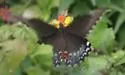
Strongly sexually dimorphic. On the upper side the male has a very broad yellow median band, wider than any other species in its range, and long all-black tails. Females are dark brown with short, stubby tails. Both sexes have a row of yellow crescent-shaped spots along the hindwing margin. Females hind wings may have a metallic bluish sheen above, and typically have two additional concentric rows of crescents, one bluish, and a reddish row inside that (on upper side, inner rows may be faint or absent, and nearly all crescents may vary to yellowish, greenish or bluish). Female forewing is paler apically than toward the base, divided by a stripe of yellowish curving through middle and along leading edge (stronger on under side than upper side). In south Texas, subspecies pallas can be confused with P. ornythion , but male P. astyalus pallas have a broader yellow median band above, with eighth spot up from the bottom in that band long and undivided. Hind wing tails average shorter and tend to be bent outward at the base. There is usually a prominent (often divided) yellow spot in the upper forwing discal cell that is usually lacking in P. ornythion . Female P. astyalus pallas have hind wings with a short narrow tail and often additional tail-like projections at ends of other veins, and they have a different spot pattern (see above). Specimens of P. astyalus bajaensis (western Mexico, sneaking into se. Arizona) have been confused with P. ornythion (to which they are very similar), but P. ornythion does not occur in that region. In males, this subspecies has a narrower upper forwing postmedian band and commonly lacks the pale spot in the discal cell, but is otherwise like subspecies pallas . Females usually have wings shaped like males, but the color pattern is like that of other P. astyalus . Note on MPG site that's not adopted by BOA: Papilio pallas Gray, [1853], formerly a subspecies of 4173 Papilio astyalus Godart, 1819 (extralimital to North America north of Mexico), is elevated back to full species status, ZooKeys, 468: 121.
Classification
- Kingdom
- Animalia
- Phylum
- Arthropoda
- Class
- Insecta
- Order
- Lepidoptera (Butterflies and Moths)
- Superfamily
- Papilionoidea
- Family
- Papilionidae (Swallowtails, Parnassians)
- Subfamily
- Papilioninae
- Tribe
- Papilionini
- Genus
- Heraclides
Imported taxonomy record. Source availability varies; see the source references and editorial policy below.
Habitat and Range
Habitat
Subtropical; females favor more wooded habitats, with males favoring more open areas nearby.
Geographic Range
s. TX & se AZ (as strays) to mid-Amazon - Map (MPG, BOA) TX subspecies: pallas (considered to be a full sp. by Shiraiwa et al. 2014 , but not by Pelham ) AZ subspecies: bajaensis Type locality ( pallas ): Oaxaca, Mexico Type locality ( hozaus ): Costa Rica Type locality( bajaensis ): San Antonio microwave tower, Baja California Sur, Mexico
Seasonal Activity
Apr-Oct in s. TX (MPG)
Diet and Behavior
Diet: Caterpillars eat foliage of plants in the Citrus Family ( Citrus, Ruta, Zanthoxylum , Rutaceae). Adults feed on flower nectar.
About Butterflies and Moths: the wider group
Order-level background for Lepidoptera, the group containing Heraclides pallas. Species-specific details appear above.
Group overview
Lepidoptera includes approximately 180,000 described species of butterflies and moths. Moths outnumber butterflies roughly 10:1. The monarch butterfly's eastern population has declined by more than 80% since the mid-1990s, and the western population by over 95% since the 1980s. The IUCN lists the migratory monarch as Vulnerable.
Ecological role of the group
Butterflies and moths are essential indicators of ecosystem health. As caterpillars, they are a primary food source for birds - a single nest of blue tit chicks requires ~10,000 caterpillars. Adult moths pollinate many night-blooming plants.
Economic and practical significance of the group
Lepidoptera are critical pollinators. In Europe, grassland butterfly species have declined by almost 50% since the early 1990s. In the UK, three-quarters of butterflies are in decline. In the U.S., five butterfly species have gone extinct since 1950, with 29 listed as endangered.
Recorded sources for this group: IUCN Red List, Xerces Society, USFWS, PNAS, WWF. Imported estimates may describe particular regions or reporting periods.
Photos of Broad-banded Swallowtail - Hodges#4173 (5)
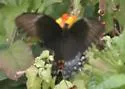
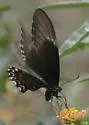
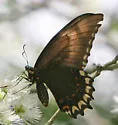
Photo credits: Contributed by Joshua Stuart Rose; Additional contributions by Steve Nanz , Mike Quinn , David Ferguson
Frequently Asked Questions About Broad-banded Swallowtail - Hodges#4173
What is Broad-banded Swallowtail - Hodges#4173?
Broad-banded Swallowtail - Hodges#4173 (Heraclides pallas) is a species in the family Papilionidae, within the order Lepidoptera.
How do you identify Broad-banded Swallowtail - Hodges#4173?
Strongly sexually dimorphic. On the upper side the male has a very broad yellow median band, wider than any other species in its range, and long all-black tails. Females are dark brown with short, stubby tails. Both sexes have a row of yellow crescent-shaped spots along the hindwing margin. Females hind wings may have a metallic bluish sheen above, and typically have two additional concentric rows of crescents, one bluish, and a reddish row inside that (on upper side, inner rows may be faint or absent, and nearly all crescents may vary to yellowish, greenish or bluish). Female forewing is paler apically than toward the base, divided by a stripe of yellowish curving through middle and along leading edge (stronger on under side than upper side). In south Texas, subspecies pallas can be confused with P. ornythion , but male P. astyalus pallas have a broader yellow median band above, with eighth spot up from the bottom in that band long and undivided. Hind wing tails average shorter and tend to be bent outward at the base. There is usually a prominent (often divided) yellow spot in the upper forwing discal cell that is usually lacking in P. ornythion . Female P. astyalus pallas have hind wings with a short narrow tail and often additional tail-like projections at ends of other veins, and they have a different spot pattern (see above). Specimens of P. astyalus bajaensis (western Mexico, sneaking into se. Arizona) have been confused with P. ornythion (to which they are very similar), but P. ornythion does not occur in that region. In males, this subspecies has a narrower upper forwing postmedian band and commonly lacks the pale spot in the discal cell, but is otherwise like subspecies pallas . Females usually have wings shaped like males, but the color pattern is like that of other P. astyalus .
Where is Broad-banded Swallowtail - Hodges#4173 found?
| Feature | Details |
|---|---|
| Habitat | Subtropical; females favor more wooded habitats, with males favoring more open areas nearby. |
| Range | s. TX & se AZ (as strays) to mid-Amazon - Map (MPG, BOA) TX subspecies: pallas (considered to be a full sp. by Shiraiwa et al. 2014 , but not by Pelham ) AZ subspecies: bajaensis Type locality ( pallas ): Oaxaca, Mexico Type locality ( hozaus ): Costa Rica Type locality( bajaensis ): San Antonio microwave tower, Baja California Sur, Mexico |
What does Broad-banded Swallowtail - Hodges#4173 eat?
The diet of the Broad-banded Swallowtail - Hodges#4173 includes Caterpillars eat foliage of plants in the Citrus Family ( Citrus, Ruta, Zanthoxylum , Rutaceae). Adults feed on flower nectar..
When is Broad-banded Swallowtail - Hodges#4173 active?
Broad-banded Swallowtail - Hodges#4173: seasonal activity - Apr-Oct in s. TX (MPG).