
Hairy Dragonfly
Brachytron pratense
This record describes Brachytron pratense (species). Recorded family: Aeshnidae. Recorded order: Odonata.
Identification and Appearance
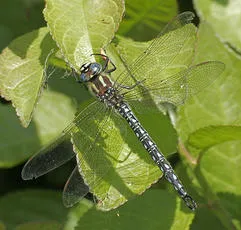
Similar in size to the Migrant Hawker, the male is black with blue spots and the female black with yellow spots. Both have a downy thorax which, in the male, has a pair of green stripes on the dorsal surface. Twin black lines on the side of the thorax are diagnostic (see illustration) . Its early flight time makes it unlikely to be confused with any other hawker. It likes clean, still waters with lots of emergent vegetation. This is the first hawker dragonfly of the year to be on the wing. It is uncommon in most of Britain though seems to be expanding its range.. Having undergone a significant range expansion across southern Britain, the Hairy Dragonfly was first recorded in VC 55 in 1993. Since this date it has been recorded at just a handful of scattered localities, though due to its early flight period it may still be under recorded. The stronghold for this species remains the Grantham Canal, at which site breeding has now been recorded, together with two other locations. The Hairy Dragonfly prefers still water sites with large amounts of emergent vegetation. No additional images available for this species.
Classification
Habitat and Range
Habitat
It likes clean, still waters with lots of emergent vegetation.
Seasonal Activity
Mid-May - June.
Diet and Behavior
Life History
This is the first hawker dragonfly of the year to be on the wing.
Additional species information
Recorded status
It is uncommon in most of Britain though seems to be expanding its range..
About Dragonflies and Damselflies: the wider group
Order-level background for Odonata, the group containing Brachytron pratense. Species-specific details appear above.
Group overview
Odonata includes ~6,000 described species of dragonflies and damselflies. Dragonflies are among the fastest flying insects, reaching 36 mph (58 km/h). They can fly in any direction including backward, and hover in place - each wing operates independently.
Ecological role of the group
Dragonflies predate dinosaurs by nearly 100 million years - fossils date to 325 million years ago. The largest dragonfly ancestor, Meganeuropsis permiana (285 mya), had a 75cm wingspan, enabled by atmospheric oxygen levels of 31-35% compared to today's 21%. Dragonflies have a 95% hunting success rate - the highest of any predator.
Economic and practical significance of the group
Dragonflies are voracious predators that consume hundreds of mosquitoes daily, providing natural pest control worth millions in reduced mosquito-borne disease risk. A single dragonfly can eat 30 to hundreds of mosquitoes per day.
Recorded sources for this group: Natural History Museum London, Britannica, fossil record research. Imported estimates may describe particular regions or reporting periods.
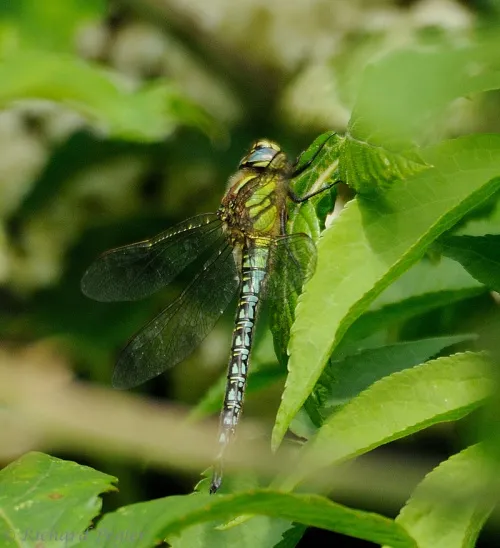
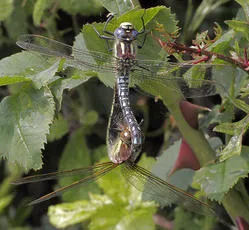
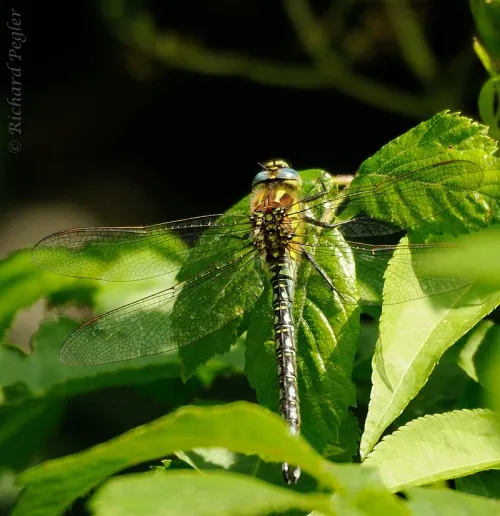
Photos of Hairy Dragonfly (4)
Frequently Asked Questions About Hairy Dragonfly
What is Hairy Dragonfly?
Hairy Dragonfly (Brachytron pratense) is a species in the family Aeshnidae, within the order Odonata.
How big is Hairy Dragonfly?
to the Migrant Hawker, the male is black with blue spots and the female black with yellow spots. Both have a downy thorax which, in the male, has a pair of green stripes on the dorsal surface.
Where is Hairy Dragonfly found?
Habitat: It likes clean, still waters with lots of emergent vegetation.
When is Hairy Dragonfly active?
Hairy Dragonfly: seasonal activity - Mid-May - June..
What is the life cycle of a Hairy Dragonfly?
This is the first hawker dragonfly of the year to be on the wing.