
Giant House Spider
Eratigena duellica
This record describes Eratigena duellica (species). Recorded family: Agelenidae. Recorded order: Araneae.
Identification and Appearance
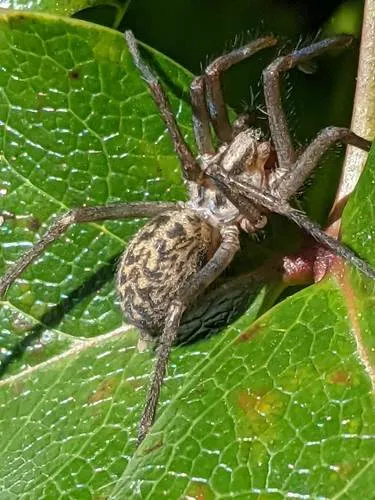
Eratigena duellica, the giant house spider, is a species of funnel weaver in the spider family Agelenidae. It is found in Canada, the United States, and Europe. The related species Eratigena atrica is also called the Giant house spider.
Identification notes
No banding on the legs, but proportionally longer legs than its relatives Eratigena agrestis and Tegenaria domestica . However, it appears that very young giant house spiders may actually have faint banding on the legs.
Wikipedia reference for Eratigena duellica: https://en.wikipedia.org/wiki/Eratigena duellica.
Classification
- Kingdom
- Animalia
- Phylum
- Arthropoda
- Class
- Arachnida
- Order
- Araneae (Spiders)
- Family
- Agelenidae (Funnel Weavers)
- Subfamily
- Ageleninae
- Genus
- Eratigena
Imported taxonomy record. Source availability varies; see the source references and editorial policy below.
Habitat and Range
Habitat
In comparing the ranges of E. duellica and E. agrestis , E. duellica is more common in coastal locations and E. agrestis dominating the interior. Anecdotal evidence suggests that, where the two species are sympatric, E. duellica “out-competes” E. agrestis although the nature of their relationship is unclear. (Link #2, See Internet Reference section below.) In an unpublished study (1980s) by Rod Crawford , Curator of Arachnids at the Burke Museum, E. duellica was found to outnumber E. agrestis by about 50 to 1 in Seattle-area house properties that had been occupied largely by E. agrestis 20 years before. "Natural" populations found on cliff faces and rocky areas. ~ Rod Crawford When found around human structures, it is often located in darker areas, such as flower beds, wood piles, and areas where it can weave a funnel-web. When it is found in homes, it often is found in the darker recesses of the basement, such as corners. It is a nocturnal spider, so generally it is discovered when the lights are turned on and the spider darts for cover (and/or its web).
Geographic Range
Main population located in BC, OR, & WA. ( 3 )
Diet and Behavior
Diet: Insects, possibly other spiders.
Life History
Life cycle images: Egg sacs (spiderling, juvenile, molted skin, adult female & male)
Additional species information
Species notes from the sources
Etymology: C.L. Koch, 1843
About Spiders: the wider group
Order-level background for Araneae, the group containing Eratigena duellica. Species-specific details appear above.
Group overview
As of 2023, 51,673 spider species in 136 families have been recorded, though an estimated 150,000 species exist. Spiders rank 7th in total species diversity among all organism orders. Only 0.5% of spider species pose any risk to human health.
Ecological role of the group
Spider venom contains complex peptides with diverse pharmacological activities, making them valuable for drug development research. Spiders produce up to 7 types of silk from specialized glands. Spider silk genes have been inserted into mammals and plants for biotech applications.
Economic and practical significance of the group
The global spider community kills an estimated 400-800 million tons of prey annually (2017 study). Spiders provide billions of dollars in natural pest control for agriculture. Spider silk is 5× stronger than steel of the same diameter, driving a biomaterials research industry.
Recorded sources for this group: World Spider Catalog, PNAS, Nature, ScienceDirect. Imported estimates may describe particular regions or reporting periods.
Photos of Giant House Spider (8)
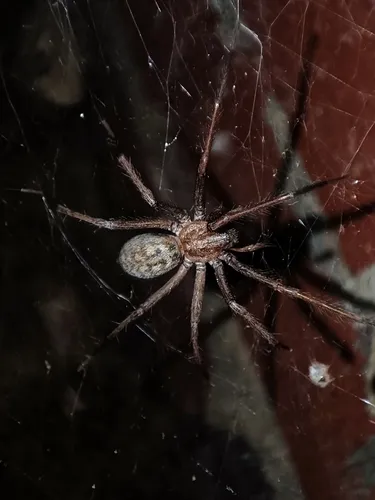
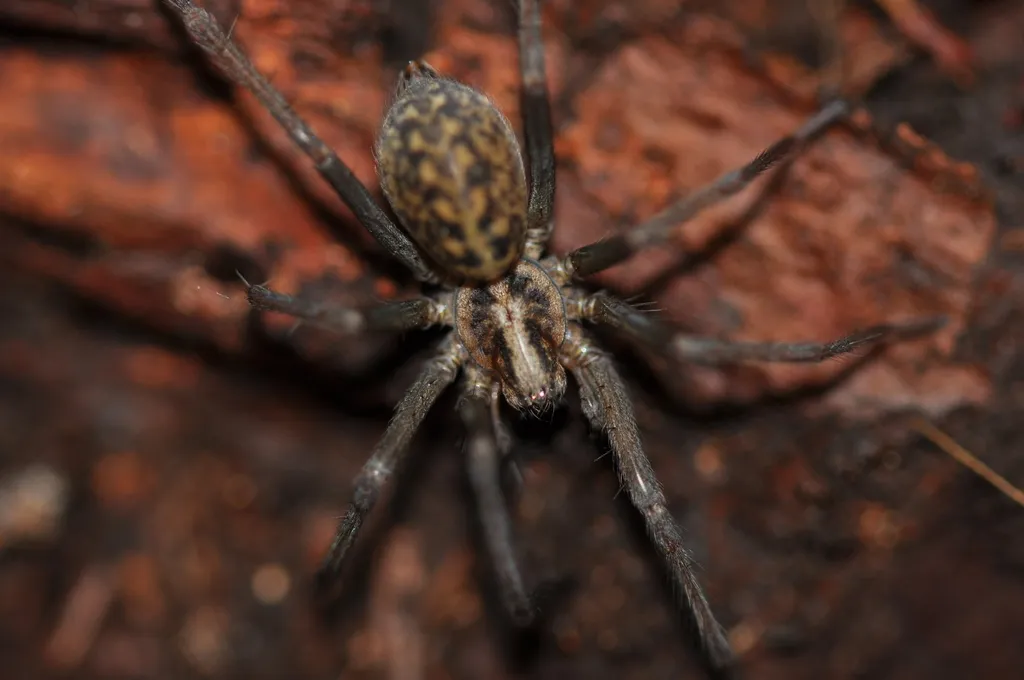
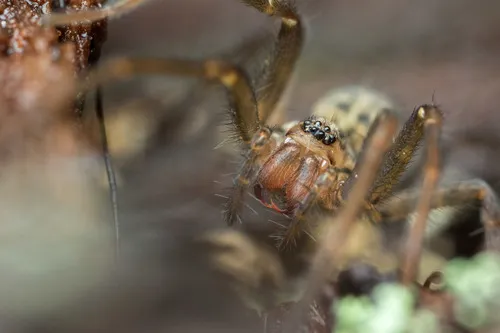
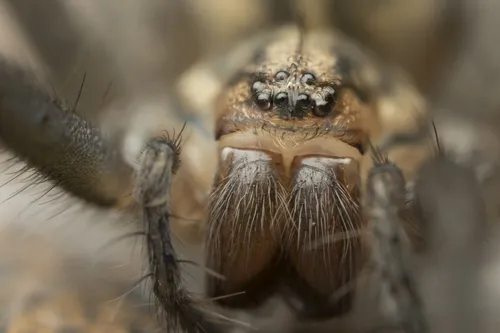
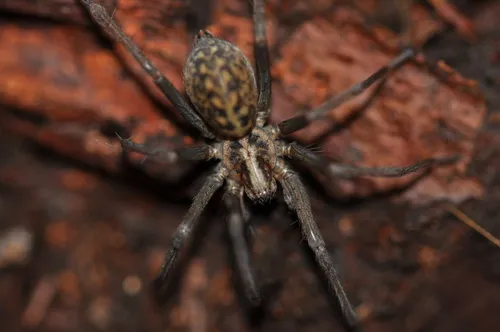
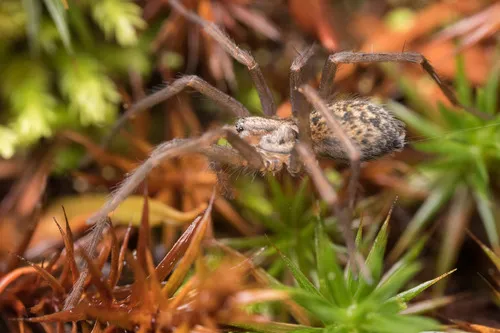
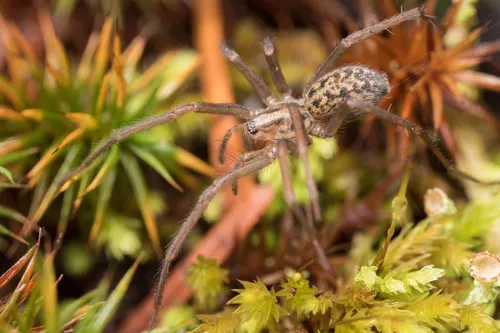
Photo credits: (c) Leah Ramsay, some rights reserved (CC BY-NC), uploaded by Leah Ramsay | (c) Thomas Barbin, some rights reserved (CC BY-NC), uploaded by Thomas Barbin | (c) pdawson9229, some rights reserved (CC BY-NC), uploaded by pdawson9229 | (c) Manuel Horcajuelo, all rights reserved, uploaded by Manuel Horcajuelo | Contributed by Christopher Hunt; Additional contributions by Lynette Elliott , Jay Barnes , Jeff Hollenbeck , cheins , Chuck Entz , kschnei , Mandy Howe , Laura P. , chuuuuung
Frequently Asked Questions About Giant House Spider
What is Giant House Spider?
Giant House Spider (Eratigena duellica) is a species in the family Agelenidae, within the order Araneae.
How big is Giant House Spider?
All measurements are for only the body, and do not include the legs. Females: approximately 16-18 mm. Males: smaller, approximately 10-12 mm.
How do you identify Giant House Spider?
No banding on the legs, but proportionally longer legs than its relatives Eratigena agrestis and Tegenaria domestica . However, it appears that very young giant house spiders may actually have faint banding on the legs.
Where is Giant House Spider found?
| Feature | Details |
|---|---|
| Habitat | In comparing the ranges of E. duellica and E. agrestis , E. duellica is more common in coastal locations and E. agrestis dominating the interior. Anecdotal evidence suggests that, where the two species are sympatric, E. duellica out-competes E. agrestis although the nature of their relationship is unclear. (Link #2, See Internet Reference section below.) In an unpublished study (1980s) by Rod Crawford , Curator of Arachnids at the Burke Museum, E. duellica was found to outnumber E. agrestis by about 50 to 1 in Seattle-area house properties that had been occupied largely by E. agrestis 20 years before. Natural populations found on cliff faces and rocky areas. ~ Rod Crawford When found around human structures, it is often located in darker areas, such as flower beds, wood piles, and areas where it can weave a funnel-web. When it is found in homes, it often is found in the darker recesses of the basement, such as corners. It is a nocturnal spider, so generally it is discovered when the lights are turned on and the spider darts for cover (and/or its web). |
| Range | Main population located in BC, OR, & WA. ( 3 ) |
What does Giant House Spider eat?
The diet of the Giant House Spider includes Insects, possibly other spiders..
What is the life cycle of a Giant House Spider?
Life cycle images: Egg sacs (spiderling, juvenile, molted skin, adult female & male)