
Epimartyria pardella - Hodges#0002
Epimartyria pardella
This record describes Epimartyria pardella (species). Recorded family: Micropterigidae. Recorded order: Lepidoptera.
Identification and Appearance
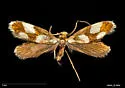
| Feature | Details |
|---|---|
| Head | Head light orangish-brown, long-haired or scaled. No proboscis but functioning mandibles, mouth pale brown to brownish-yellow. Antenna: Base (scape) and pedicel light orangish-brown. Segments dark brownish-gray with golden hairs (scales). |
| Thorax | Brown with reddish to purplish luster. Sides light orangish-brown. Wings: Forewings brown with coppery luster. Base has faint yellow spot and yellow speckling. One large yellow spot on costal edge starting at mid-wing. A large yellow crescent shape on inner margin starting at mid-wing and bending toward head. A small yellow spot at anal angle. Fringe at wing tip yellow, rest gray-brown. Hindwing and fringe gray. |
| Legs | Brown with long yellow streaks or spots. Front shin has a small spur at center (lacking on the other two species). |
| Abdomen | Dark brownish-gray, hairy scales are lighter brown. Photo https://www.flickr.com/photos/pulk/7446377746 Types: Lectotype as Micropteryx pardella male by Walsingham, 1880. #90591. Locality: Klamath County; Redwood forests, south Oregon, June 1872. Lectotype designated by Davis & Landry, 2012. Genitalia Slide #25352. In British Museum of Natural History, London, England. The lectotype has been selected from a series of the five original syntypes collected by Walsingham. |
Classification
- Kingdom
- Animalia
- Phylum
- Arthropoda
- Class
- Insecta
- Order
- Lepidoptera (Butterflies and Moths)
- Superfamily
- Micropterigoidea
- Family
- Micropterigidae (Mandibulate Archaic Moths)
- Genus
- Epimartyria
Imported taxonomy record. Source availability varies; see the source references and editorial policy below.
Habitat and Range
Habitat
Canyons bordering redwood forests. The steep canyon walls are moist and prolific with ferns, mosses and liverwort.
Geographic Range
Southern Oregon to northern California. ( 3 )
Seasonal Activity
Late May to mid-July, abundant in June.
Diet and Behavior
Diet: Prefers Liverwort Pellia species , but also uses Great Scented Liverwort Conocephalum conicum .
Life History
Moths are day flying, but spend most of their time stationery or within 30 cm (1 foot) of their food plants. Although flowering plants were available, adults were seen only drinking water and would die within 2 days if no water was available. Eggs laid on underside of the liverwort leaves; hatched in 3 weeks. Larvae have a 2 year life cycle and 3 instars. Older larvae feed on underside of leaves at night. Larvae 4.5 mm long. Brown head, prominent antenna, mandibles dark brown. Body tapers at both ends; dark brown, lighter on underside. Shield has 10 hairs. Thorax has 8 hairs. Thoracic legs brown. Al to A8 (and T2 and T3) ridged with one hair on ridge. Brown, wrinkled. 8 small prolegs. Pupation occurs on ground vegetation. Cocoon brown, oval, about 5 mm long. Made of silk with some debris and attached to vegetation.
Additional species information
Species notes from the sources
Etymology: Specific epithet from ancient Greek pardus meaning "leopard" for the spotted wings.
About Butterflies and Moths: the wider group
Order-level background for Lepidoptera, the group containing Epimartyria pardella. Species-specific details appear above.
Group overview
Lepidoptera includes approximately 180,000 described species of butterflies and moths. Moths outnumber butterflies roughly 10:1. The monarch butterfly's eastern population has declined by more than 80% since the mid-1990s, and the western population by over 95% since the 1980s. The IUCN lists the migratory monarch as Vulnerable.
Ecological role of the group
Butterflies and moths are essential indicators of ecosystem health. As caterpillars, they are a primary food source for birds - a single nest of blue tit chicks requires ~10,000 caterpillars. Adult moths pollinate many night-blooming plants.
Economic and practical significance of the group
Lepidoptera are critical pollinators. In Europe, grassland butterfly species have declined by almost 50% since the early 1990s. In the UK, three-quarters of butterflies are in decline. In the U.S., five butterfly species have gone extinct since 1950, with 29 listed as endangered.
Recorded sources for this group: IUCN Red List, Xerces Society, USFWS, PNAS, WWF. Imported estimates may describe particular regions or reporting periods.
Frequently Asked Questions About Epimartyria pardella - Hodges#0002
What is Epimartyria pardella - Hodges#0002?
Epimartyria pardella - Hodges#0002 (Epimartyria pardella) is a species in the family Micropterigidae, within the order Lepidoptera.
How big is Epimartyria pardella - Hodges#0002?
| Feature | Description |
|---|---|
| Wingspan | Wingspan 10-11 mm. |
| Forewing | Forewing length 4.5-5.5 mm. |
How do you identify Epimartyria pardella - Hodges#0002?
| Feature | Details |
|---|---|
| Head | Head light orangish-brown, long-haired or scaled. No proboscis but functioning mandibles, mouth pale brown to brownish-yellow. Antenna: Base (scape) and pedicel light orangish-brown. Segments dark brownish-gray with golden hairs (scales). |
| Thorax | Brown with reddish to purplish luster. Sides light orangish-brown. Wings: Forewings brown with coppery luster. Base has faint yellow spot and yellow speckling. One large yellow spot on costal edge starting at mid-wing. A large yellow crescent shape on inner margin starting at mid-wing and bending toward head. A small yellow spot at anal angle. Fringe at wing tip yellow, rest gray-brown. Hindwing and fringe gray. |
| Legs | Brown with long yellow streaks or spots. Front shin has a small spur at center (lacking on the other two species). |
| Abdomen | Dark brownish-gray, hairy scales are lighter brown. Photo https://www.flickr.com/photos/pulk/7446377746 |
Where is Epimartyria pardella - Hodges#0002 found?
| Feature | Details |
|---|---|
| Habitat | Canyons bordering redwood forests. The steep canyon walls are moist and prolific with ferns, mosses and liverwort. |
| Range | Southern Oregon to northern California. ( 3 ) |
What does Epimartyria pardella - Hodges#0002 eat?
The diet of the Epimartyria pardella - Hodges#0002 includes Prefers Liverwort Pellia species , but also uses Great Scented Liverwort Conocephalum conicum ..
When is Epimartyria pardella - Hodges#0002 active?
Epimartyria pardella - Hodges#0002: seasonal activity - Late May to mid-July, abundant in June..
What is the life cycle of a Epimartyria pardella - Hodges#0002?
| Feature | Description |
|---|---|
| Additional details | Moths are day flying, but spend most of their time stationery or within 30 cm (1 foot) of their food plants. Although flowering plants were available, adults were seen only drinking water and would die within 2 days if no water was available. Eggs laid on underside of the liverwort leaves; hatched in 3 weeks. Larvae have a 2 year life cycle and 3 instars. Older larvae feed on underside of leaves at night. Larvae 4.5 mm long. Brown head, prominent antenna, mandibles dark brown. |
| Body | Body tapers at both ends; dark brown, lighter on underside. Shield has 10 hairs. |
| Thorax | Thorax has 8 hairs. Thoracic legs brown. Al to A8 (and T2 and T3) ridged with one hair on ridge. Brown, wrinkled. 8 small prolegs. Pupation occurs on ground vegetation. Cocoon brown, oval, about 5 mm long. Made of silk with some debris and attached to vegetation. |