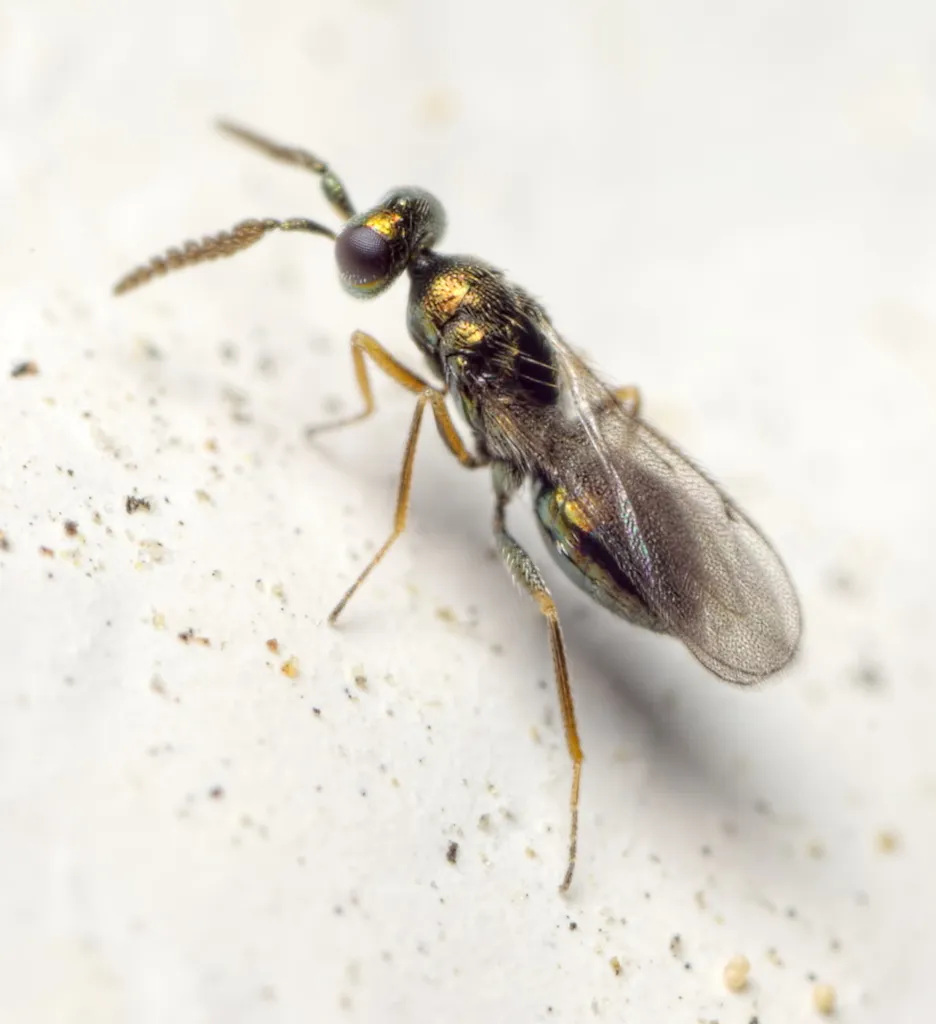
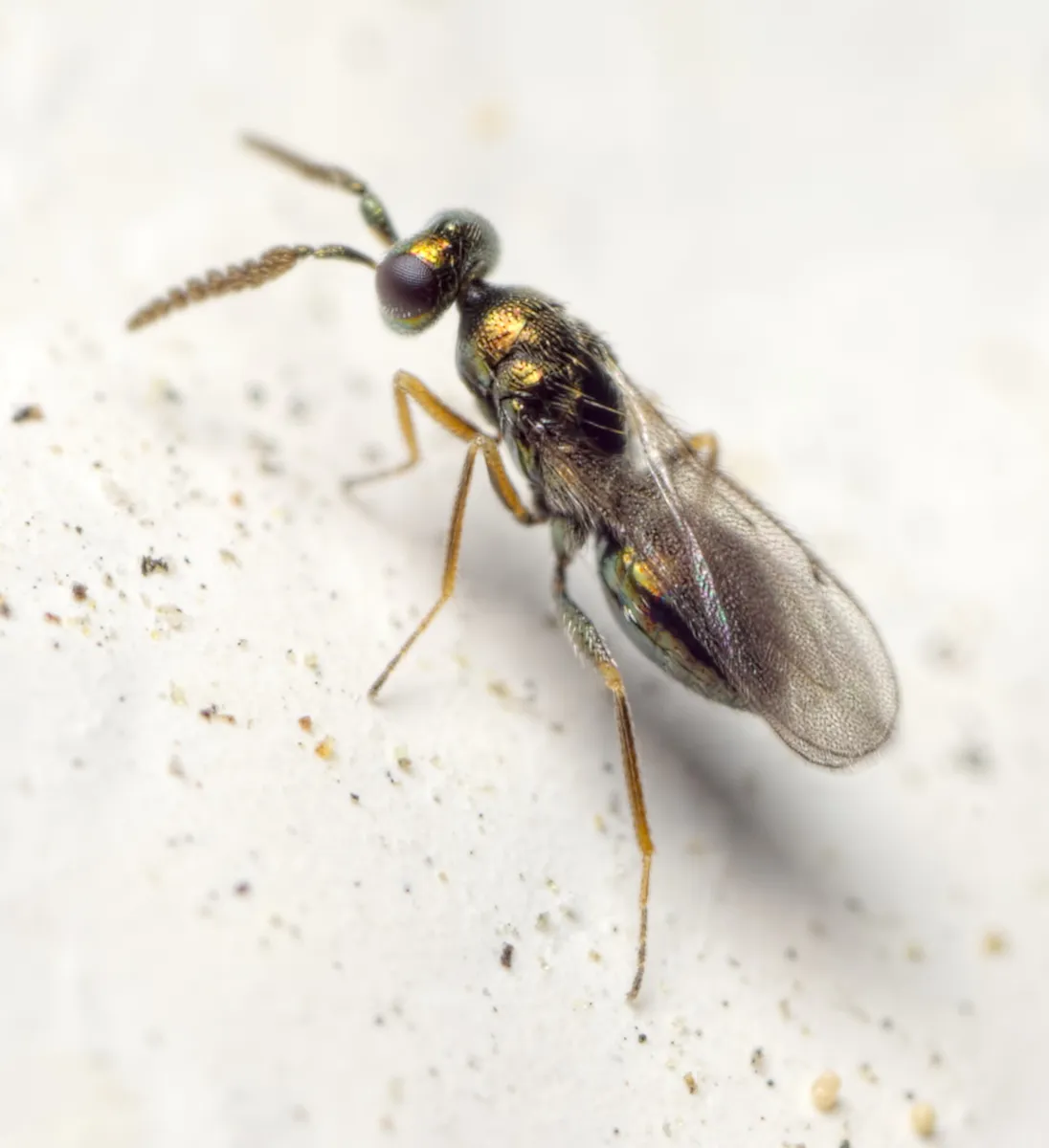
Epiclerus panyas
This record describes Epiclerus panyas (species). Recorded family: Tetracampidae. Recorded order: Hymenoptera.
Identification and Appearance
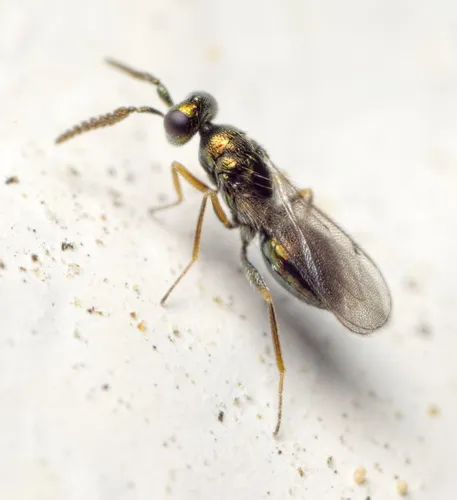
A tiny (~2mm) jewel wasp with a dark, shimmering metallic blue-green or bronze appearance. Legs are mostly dark (concolorous with the body) at the base (coxae), but the tibiae are often paler or yellowish-brown. Males have 4-segmented tarsi on all legs, females have 5-segmented tarsi. The antennae are geniculate (elbowed) and provide the best way to distinguish E. panyas from its close relatives. The antennae typically have a 11-segmented antennae (including a tiny ring-like segment called an anellus). The marginal vein of the forewing is very long compared to the other veins. The postmarginal vein is significantly longer than the stigmal vein (the little thumb vein). In many similar wasps, these two are roughly equal, but in Epiclerus , the postmarginal vein clearly extends much further along the wing edge. Females: tarsi 5-segmented; propodeum very densely setose, medially with many punctures bearing white hairs, without reticulations; petiole with almost parallel edges, twice as long as broad in the middle; the last flagellar segment transverse. Microscopic examination and photos of key features required. Primarily found in grassy areas where its hosts - leaf-mining flies such as Chromatomyia & Phytomyza - are abundant. One of the primary parasitoids of the common fly-miner Phytomyza ranunculi on Creeping Buttercup. Very few observations due to identificaton difficulty. Probably common. No additional images available for this species.
Classification
- Kingdom
- Animalia
- Phylum
- Arthropoda
- Class
- Insecta
- Order
- Hymenoptera
- Family
- Tetracampidae
- Genus
- Epiclerus
Imported taxonomy record. Source availability varies; see the source references and editorial policy below.
Habitat and Range
Habitat
Primarily found in grassy areas where its hosts - leaf-mining flies such as Chromatomyia & Phytomyza - are abundant. One of the primary parasitoids of the common fly-miner
Additional species information
Recorded status
Very few observations due to identificaton difficulty. Probably common.
About Flies: the wider group
Order-level background for Hymenoptera, the group containing Epiclerus panyas. Species-specific details appear above.
Group overview
Hymenoptera includes over 150,000 described species of ants, bees, wasps, and sawflies. Earth harbors approximately 20 quadrillion (20×10^15) ants, with a combined biomass of ~12 megatons of dry carbon - exceeding the combined biomass of all wild birds and mammals (PNAS, 2022).
Ecological role of the group
About 35% of the world's food crops depend on animal pollinators. The chocolate industry, valued at over $100 billion, depends on pollinating flies and midges. Ants are the dominant soil engineers in most terrestrial ecosystems, turning more soil than earthworms in many habitats.
Economic and practical significance of the group
Pollinators contribute $235-577 billion worth of annual global food production (FAO). In the U.S., bee pollination alone benefits crops valued at $18 billion annually, and honey bees are responsible for $5.4 billion in agricultural productivity. Between April 2023-2024, 55.1% of managed honey bee colonies were lost. The U.S. bee population dropped from 5 million to 2.5 million.
Recorded sources for this group: FAO, USDA, EPA, PNAS (2022), US Fish & Wildlife Service. Imported estimates may describe particular regions or reporting periods.