
Duck Mussel
Anodonta anatina
This record describes Anodonta anatina (species). Recorded family: Unionidae. Recorded order: Unionoida.
Identification and Appearance
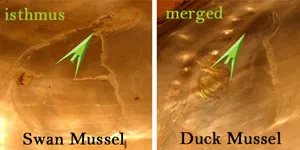
One of the largest of our freshwater bivalves, typically 75mm but up to 120mm in length. It has a thin shell and is generally slim when closed. Brown and yellow in colour. The hinge margin is notably angled from the mid-axis. The Swan Mussel, Anadonta cygnea , is larger and the hinge margin is parallel to the mid-axis. The two can also be distinguished by looking at the posterior (pointed end) adductor muscle scar. In the Swan Mussel, the scar is joined to the pedal retractor scar by a narrow isthmus, whereas in the Duck Mussel these two scars are completely merged. Unless identified by a recognised expert, photographic evidence is required. A photo of the adductor scar is often needed. Note the shell's size. If it is an empty shell, it is advisable to retain this in case further checks are needed. Diverse. Small streams to large rivers, lakes, ponds and canals. Common and widespread in England, less so in Wales and Scotland.
Classification
Habitat and Range
Habitat
Diverse. Small streams to large rivers, lakes, ponds and canals.
Seasonal Activity
All year
Additional species information
Recorded status
Common and widespread in England, less so in Wales and Scotland.
About Unionoida: the wider group
Order-level background for Unionoida, the group containing Anodonta anatina. Species-specific details appear above.
Group overview
This is a smaller arthropod order with specialized ecological roles. Arthropods are the most diverse animal phylum, comprising over 80% of all known animal species with approximately 1.2 million described species globally.
Ecological role of the group
Members of this order contribute to broader arthropod ecosystem functions including decomposition, predation, and serving as food sources for vertebrates. Arthropod biodiversity is essential for ecosystem resilience.
Economic and practical significance of the group
While this order has limited direct economic impact, arthropods collectively provide ecosystem services worth trillions of dollars annually through pollination, decomposition, pest control, and nutrient cycling.
Recorded sources for this group: General entomology and arthropod research. Imported estimates may describe particular regions or reporting periods.
Frequently Asked Questions About Duck Mussel
What is Duck Mussel?
Duck Mussel (Anodonta anatina) is a species in the family Unionidae, within the order Unionoida.
Where is Duck Mussel found?
Habitat: Diverse. Small streams to large rivers, lakes, ponds and canals.
When is Duck Mussel active?
Duck Mussel: seasonal activity - All year.