
Dolomedes tenebrosus
This record describes Dolomedes tenebrosus (species). Recorded family: Dolomedidae. Recorded order: Araneae.
Identification and Appearance
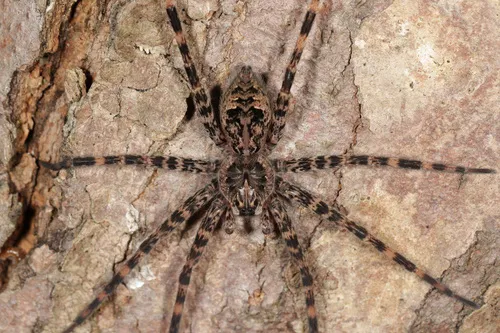
Brownish to gray with few white marks, dark W-shaped marks on dorsal surface of abdomen. Note that mature females are much larger than mature males--see Life Cycle . The main difference between scriptus and tenebrosus is that the 'W' pattern on scriptus is outlined in white all the way across the abdomen. The pattern in tenebrosus is broken.. and it generally has less white. It also appears that scriptus has a fuller and more complete median carapace stripe. Dolomedes scriptus Dolomedes tenebrosus Additionally Dolomedes tenebrosus features an inverted v shaped black mark beginning at the AME extending to the edge of the clypeus enclosing a light spot on the anteromedial margin compared to Dolomedes scriptus which is dark only around each eye with a homogenous medium gray clypeus : Dolomedes scriptus Dolomedes tenebrosus Epigynum: Palp:
Classification
- Kingdom
- Animalia
- Phylum
- Arthropoda
- Class
- Arachnida
- Order
- Araneae (Spiders)
- Family
- Dolomedidae (Fishing Spiders)
- Genus
- Dolomedes (Fishing Spiders)
Imported taxonomy record. Source availability varies; see the source references and editorial policy below.
Habitat and Range
Habitat
Bushes, rocks, trees, etc., near permanent bodies of water. Also in dry woodlands far from water. D. tenebrosus is the Dolomedes species most commonly found in human dwellings. After they've dispersed from the nursery web, juveniles may be found perched on on leaves, within holes in leaves, or on small stems or branches. These resting locations may be covered with strands of silk.
Geographic Range
Eastern North America: southeastern Canada south to the Florida panhandle, west to North Dakota, Texas. Generally replaced by the visually similar D. okefinokensis in swamp regions of peninsular Florida and southern Georgia
Diet and Behavior
Life History
The male of this species always dies during mating (Schwartz et al., 2013). There is extreme sexual dimorphism and divergence in life histories. Quoting Schwartz et al., with references removed: A YouTube video of the male and female mating can be seen here .
Additional species information
Species notes from the sources
Etymology: Latin: "dark, gloomy"
About Spiders: the wider group
Order-level background for Araneae, the group containing Dolomedes tenebrosus. Species-specific details appear above.
Group overview
As of 2023, 51,673 spider species in 136 families have been recorded, though an estimated 150,000 species exist. Spiders rank 7th in total species diversity among all organism orders. Only 0.5% of spider species pose any risk to human health.
Ecological role of the group
Spider venom contains complex peptides with diverse pharmacological activities, making them valuable for drug development research. Spiders produce up to 7 types of silk from specialized glands. Spider silk genes have been inserted into mammals and plants for biotech applications.
Economic and practical significance of the group
The global spider community kills an estimated 400-800 million tons of prey annually (2017 study). Spiders provide billions of dollars in natural pest control for agriculture. Spider silk is 5× stronger than steel of the same diameter, driving a biomaterials research industry.
Recorded sources for this group: World Spider Catalog, PNAS, Nature, ScienceDirect. Imported estimates may describe particular regions or reporting periods.
Photos of Dolomedes tenebrosus (2)
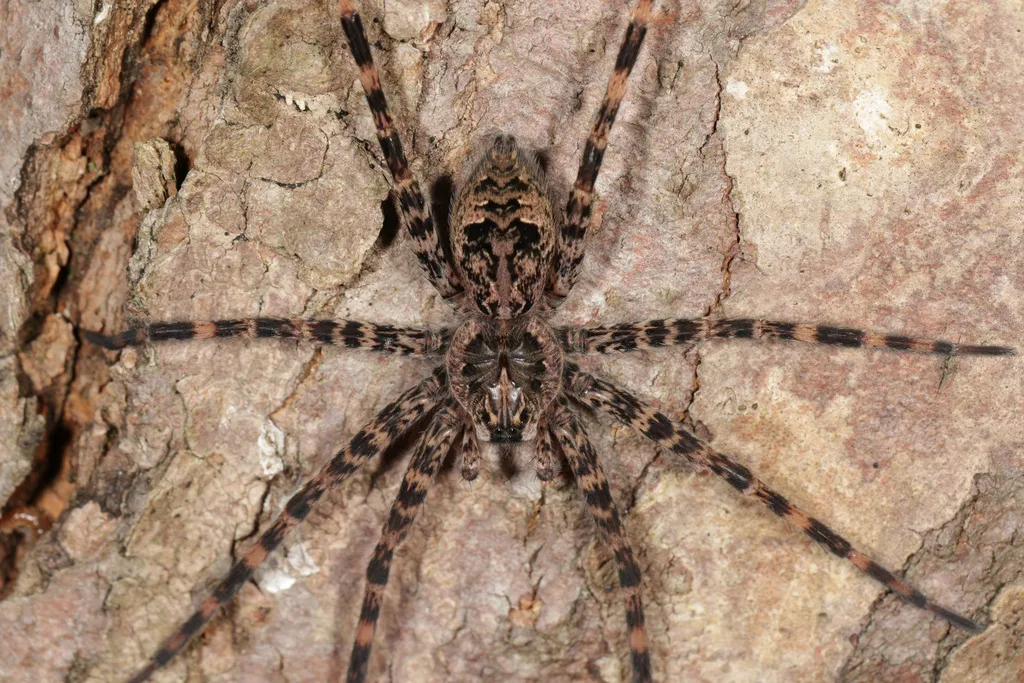
Photo credits: Contributed by Troy Bartlett; Additional contributions by cotinis , Lynette Elliott , cheins , Chuck Entz , Laura P. , Nathaniel Green , chuuuuung
Frequently Asked Questions About Dolomedes tenebrosus
What is Dolomedes tenebrosus?
Dolomedes tenebrosus is a species in the family Dolomedidae, within the order Araneae.
How big is Dolomedes tenebrosus?
body length of female 15-26 mm, of male, 7-13 mm
How do you identify Dolomedes tenebrosus?
Brownish to gray with few white marks, dark W-shaped marks on dorsal surface of abdomen. Note that mature females are much larger than mature males--see Life Cycle . The main difference between scriptus and tenebrosus is that the 'W' pattern on scriptus is outlined in white all the way across the abdomen. The pattern in tenebrosus is broken.. and it generally has less white. It also appears that scriptus has a fuller and more complete median carapace stripe. Dolomedes scriptus Dolomedes tenebrosus Additionally Dolomedes tenebrosus features an inverted v shaped black mark beginning at the AME extending to the edge of the clypeus enclosing a light spot on the anteromedial margin compared to Dolomedes scriptus which is dark only around each eye with a homogenous medium gray clypeus : Dolomedes scriptus Dolomedes tenebrosus Epigynum: Palp:
Where is Dolomedes tenebrosus found?
| Feature | Details |
|---|---|
| Habitat | Bushes, rocks, trees, etc., near permanent bodies of water. Also in dry woodlands far from water. D. tenebrosus is the Dolomedes species most commonly found in human dwellings. After they've dispersed from the nursery web, juveniles may be found perched on on leaves, within holes in leaves, or on small stems or branches. These resting locations may be covered with strands of silk. |
| Range | Eastern North America: southeastern Canada south to the Florida panhandle, west to North Dakota, Texas. Generally replaced by the visually similar D. okefinokensis in swamp regions of peninsular Florida and southern Georgia |
What is the life cycle of a Dolomedes tenebrosus?
The male of this species always dies during mating (Schwartz et al., 2013). There is extreme sexual dimorphism and divergence in life histories. Quoting Schwartz et al., with references removed: A YouTube video of the male and female mating can be seen here .