
Dog Flea
Ctenocephalides canis
This record describes Ctenocephalides canis (species). Recorded family: Pulicidae. Recorded order: Siphonaptera.
Identification and Appearance
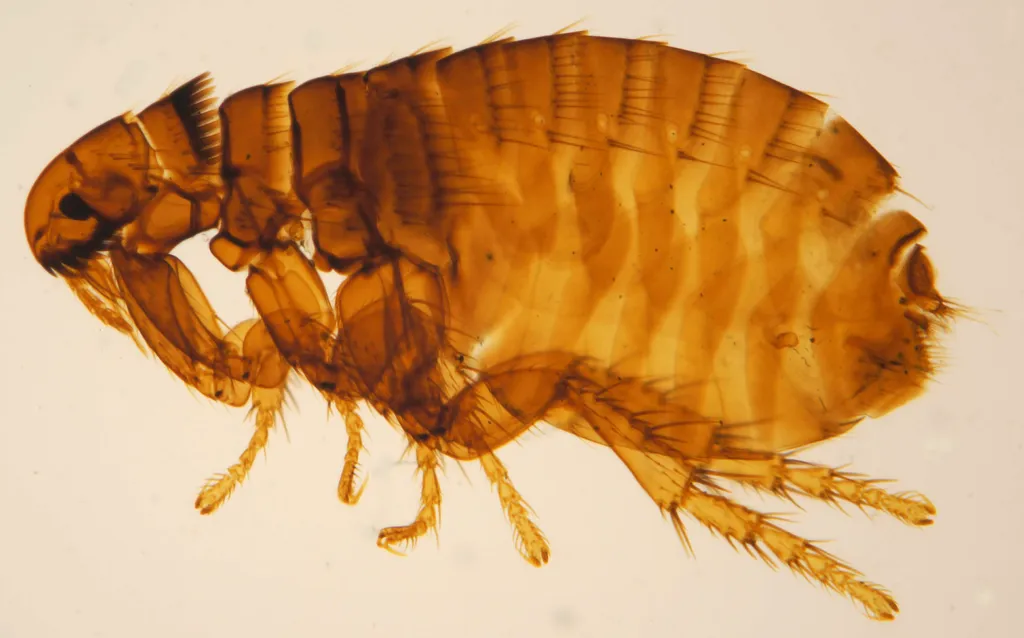
Comments here (and also quoted below in some other sections) from Jerrod Johnson and Foundations of Parasitology textbook: The adult dog flea can only be identified microscopically. The head is more rounded anteriorly than the more common cat flea ( Ctenocephalides felis ). The first genal comb (ctenidium) is shorter than the remaining row of ctenidia. The arrangement of setae on the hind tarsi may be used to confirm identification (a key can be found on the CDC website). Fleas are known to be carriers of many human diseases such as bubonic plaque, murine typhus, etc. They are responsible for transmission of Bartonella henselae which is the causative agent of Cat Scratch Disease. They act as intermediate hosts for the feline and canine cucumber seed tapeworm Dipyllidium caninum .
Wikipedia reference for Ctenocephalides canis: http://en.wikipedia.org/wiki/Dog_flea.
Classification
- Kingdom
- Animalia
- Phylum
- Arthropoda
- Class
- Insecta
- Order
- Siphonaptera (Fleas)
- Family
- Pulicidae
- Genus
- Ctenocephalides (Cat and Dog Fleas)
Imported taxonomy record. Source availability varies; see the source references and editorial policy below.
Habitat and Range
Geographic Range
Cosmopolitan, more common in Europe.
Diet and Behavior
Diet: The adult feed on blood from their hosts, dogs and other mammals.
Life History
"Like other fleas, the dog flea has a holometabolous life cycle and the time from egg to adult is usually 21 days with ideal warmth and humidity. Eggs are laid on the host and usually fall to the ground and develop into small "Maggot-like" larvae that feed off of frass that also falls from the host. After 3 molts, the larvae will spin a cocoon out of silk. Substrate from the environment will adhere to the silk making a casing that protects the developing pupa from the environment, even most insecticides. Which is why most "Foggers" are completely useless against pupae and a vacuum is the best method of removal. When development is complete the newly developed flea will search for a host and the life cycle will begin again".
Additional species information
Species notes from the sources
Etymology: Ctenocephalides canis (Curtis)
About Fleas: the wider group
Order-level background for Siphonaptera, the group containing Ctenocephalides canis. Species-specific details appear above.
Group overview
Siphonaptera (fleas) includes ~2,500 described species. Fleas can jump up to 150 times their own body length - equivalent to a human jumping over a 75-story building. This makes them the best jumpers relative to body size of any animal.
Ecological role of the group
Fleas have been parasitizing mammals for at least 165 million years based on fossil evidence. They can transmit diseases including plague, murine typhus, and tapeworms. A single female flea can lay up to 50 eggs per day.
Economic and practical significance of the group
The U.S. pet flea treatment market is worth over $4.4 billion annually. Historically, rat fleas transmitted the bubonic plague (Black Death), which killed an estimated 75-200 million people in the 14th century - roughly 30-60% of Europe's population.
Recorded sources for this group: CDC, WHO, pet industry market research. Imported estimates may describe particular regions or reporting periods.
Photos of Dog Flea (2)
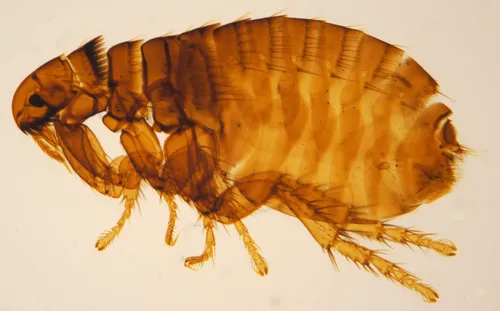
Photo credits: Contributed by Eric R. Eaton; Additional contributions by Beatriz Moisset , Mike Quinn , kschnei
Frequently Asked Questions About Dog Flea
What is Dog Flea?
Dog Flea (Ctenocephalides canis) is a species in the family Pulicidae, within the order Siphonaptera.
How big is Dog Flea?
Egg - white 0.5 mm Larvae - 1.0 mm Adult - 1.5-2.0 mm
How do you identify Dog Flea?
Comments here (and also quoted below in some other sections) from Jerrod Johnson and Foundations of Parasitology textbook: The adult dog flea can only be identified microscopically. The head is more rounded anteriorly than the more common cat flea ( Ctenocephalides felis ). The first genal comb (ctenidium) is shorter than the remaining row of ctenidia. The arrangement of setae on the hind tarsi may be used to confirm identification (a key can be found on the CDC website).
Where is Dog Flea found?
Range: Cosmopolitan, more common in Europe.
What does Dog Flea eat?
The diet of the Dog Flea includes The adult feed on blood from their hosts, dogs and other mammals..
What is the life cycle of a Dog Flea?
Like other fleas, the dog flea has a holometabolous life cycle and the time from egg to adult is usually 21 days with ideal warmth and humidity. Eggs are laid on the host and usually fall to the ground and develop into small Maggot-like larvae that feed off of frass that also falls from the host. After 3 molts, the larvae will spin a cocoon out of silk. Substrate from the environment will adhere to the silk making a casing that protects the developing pupa from the environment, even most insecticides. Which is why most Foggers are completely useless against pupae and a vacuum is the best method of removal. When development is complete the newly developed flea will search for a host and the life cycle will begin again.