
Cheiracanthium mildei
This record describes Cheiracanthium mildei (species). Recorded family: Cheiracanthiidae. Recorded order: Araneae.
Identification and Appearance
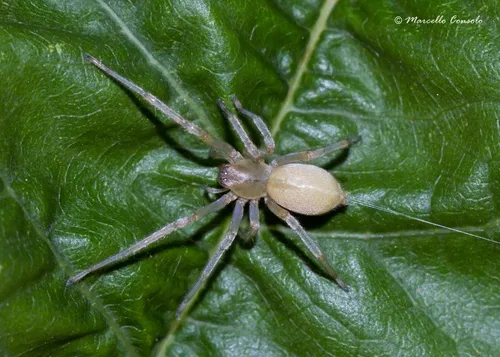
C. mildei is a relatively small, pale greenish, tan or straw-colored spider. Its front pair of legs is longer than the others, and all four pairs end in double claws. Male: The male can be recognized by having a pedipalp with 2 equally long tibial apophyses. ( C. inclusum appears to have one short apophysis and one long apophysis.) Female: epigyne Being Bitten: Yellow sac spider bites occur most frequently when the very defensive spider is trapped in clothing. As Rod Crawford points out, It turned out that the association of this spider with blisters and lesions was wrong, though accepted by everyone until recently. See the attached paper. I'd say this species ought to be taken off the medical concern list. See full article here . Sac spiders are classified as hunting spiders. These spiders are very active at night and will emerge from their day resting sacs to run along walls and ceilings in pursuit of prey. If startled, they drop down on draglines and scurry away! Imported from Europe in the 1940s.
Classification
- Kingdom
- Animalia
- Phylum
- Arthropoda
- Class
- Arachnida
- Order
- Araneae (Spiders)
- Family
- Cheiracanthiidae
- Genus
- Cheiracanthium (Long-legged Sac Spiders)
Imported taxonomy record. Source availability varies; see the source references and editorial policy below.
Habitat and Range
Habitat
They make a resting tube in a rolled leaf or under bark or stones. More often found inside man-made structures (as opposed to C. inclusum which is found more often outdoors). Habitat is not the best way to separate them, though, as BugGuide does have photos of C. mildei found outdoors. Genitalia needs to be examined for a conclusive ID.
Geographic Range
Holarctic distribution as well as southern South America (Argentina).
Seasonal Activity
Indoor populations of C. mildei are non-seasonal and can be adult at any time.
Diet and Behavior
Diet: Any small invertebrate (e.g. insects).
Life History
After mating, females lay 30-48 eggs, cover them in a thin, white silken sac and guard them. The egg sacs may be found in protected areas, or even wrapped in a folded leaf. All stages of sac spiders make a silken cell (the "sac"), in which they rest when not active.
Additional species information
Species notes from the sources
Etymology: Author: C. L. Koch, 1839
About Spiders: the wider group
Order-level background for Araneae, the group containing Cheiracanthium mildei. Species-specific details appear above.
Group overview
As of 2023, 51,673 spider species in 136 families have been recorded, though an estimated 150,000 species exist. Spiders rank 7th in total species diversity among all organism orders. Only 0.5% of spider species pose any risk to human health.
Ecological role of the group
Spider venom contains complex peptides with diverse pharmacological activities, making them valuable for drug development research. Spiders produce up to 7 types of silk from specialized glands. Spider silk genes have been inserted into mammals and plants for biotech applications.
Economic and practical significance of the group
The global spider community kills an estimated 400-800 million tons of prey annually (2017 study). Spiders provide billions of dollars in natural pest control for agriculture. Spider silk is 5× stronger than steel of the same diameter, driving a biomaterials research industry.
Recorded sources for this group: World Spider Catalog, PNAS, Nature, ScienceDirect. Imported estimates may describe particular regions or reporting periods.
Photos of Cheiracanthium mildei (2)
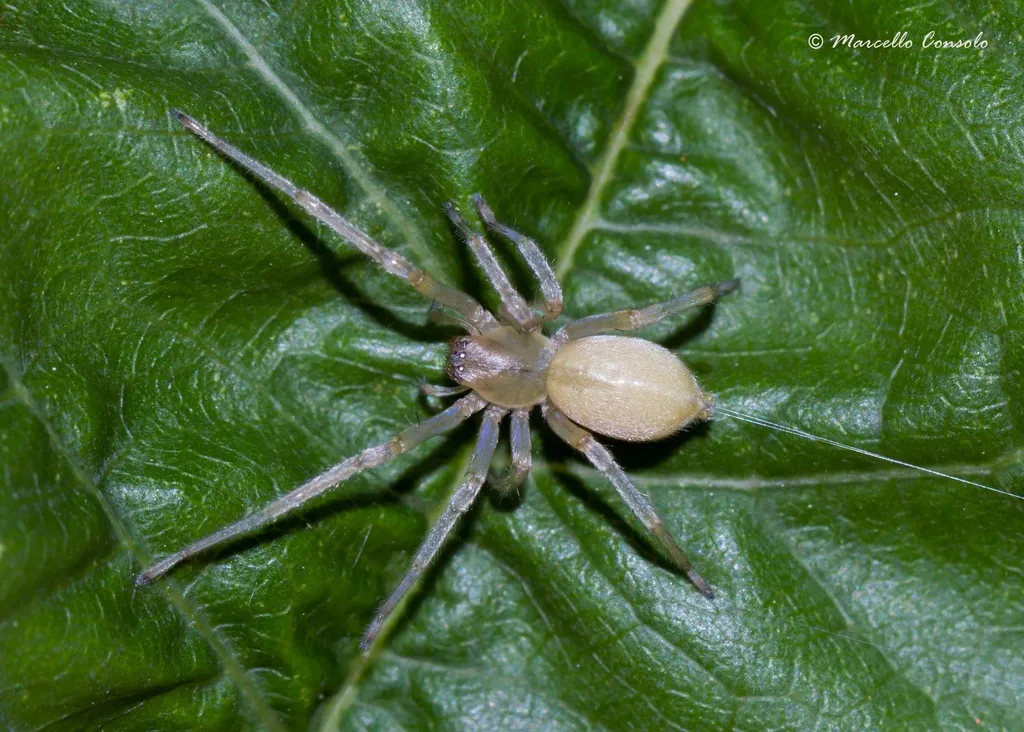
Photo credits: Contributed by Troy Bartlett; Additional contributions by Lynette Elliott , Christopher Hunt , cheins , dragonfly12 , jsloan , Mandy Howe , Laura P. , chuuuuung
Frequently Asked Questions About Cheiracanthium mildei
What is Cheiracanthium mildei?
Cheiracanthium mildei is a species in the family Cheiracanthiidae, within the order Araneae.
How big is Cheiracanthium mildei?
7-10 mm
How do you identify Cheiracanthium mildei?
C. mildei is a relatively small, pale greenish, tan or straw-colored spider. Its front pair of legs is longer than the others, and all four pairs end in double claws. Male: The male can be recognized by having a pedipalp with 2 equally long tibial apophyses. ( C. inclusum appears to have one short apophysis and one long apophysis.) Female: epigyne
Where is Cheiracanthium mildei found?
| Feature | Details |
|---|---|
| Habitat | They make a resting tube in a rolled leaf or under bark or stones. More often found inside man-made structures (as opposed to C. inclusum which is found more often outdoors). Habitat is not the best way to separate them, though, as BugGuide does have photos of C. mildei found outdoors. Genitalia needs to be examined for a conclusive ID. |
| Range | Holarctic distribution as well as southern South America (Argentina). |
What does Cheiracanthium mildei eat?
The diet of the Cheiracanthium mildei includes Any small invertebrate (e.g. insects)..
When is Cheiracanthium mildei active?
Cheiracanthium mildei: seasonal activity - Indoor populations of C. mildei are non-seasonal and can be adult at any time..
What is the life cycle of a Cheiracanthium mildei?
After mating, females lay 30-48 eggs, cover them in a thin, white silken sac and guard them. The egg sacs may be found in protected areas, or even wrapped in a folded leaf. All stages of sac spiders make a silken cell (the sac), in which they rest when not active.