
Cerocatus rufiventris
This record describes Cerocatus rufiventris (species). Recorded family: Therevidae. Recorded order: Diptera.
Identification and Appearance
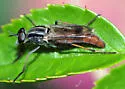
| Feature | Details |
|---|---|
| Head | Black with silvery-white pile. Antenna: Yellowish-brown, last segment brown. 1st segment quite short, unusual for Cerocatus. |
| Thorax | Segment 1 (scutum) black with 2 gray pile longitudinal stripes, one each side of center. Segment 2 (scutellum) black, the base has a white line. Thorax side blue-gray pile. Wings: Clear, more whitish, with traces of 2 grayish crossbands, one near center of wing, one near tip. Male has faint spots (may be absent) in place of bands. Veins and stigma brown. |
| Legs | Blackish-brown. White pile on thighs (femora). Feet black. Hind foot 1st segment yellowish. |
| Abdomen | Female is reddish-orange, except segment 1 black with silver-gray pile. Base of all segments (incisures) dark. Tip has a yellowish circle of bristles. Underside reddish-orange. Male abdomen black; segments 1 to 3 covered with silvery-gray pile; 4 to 6 shiny black; tip reddish-yellow, hairy. Types: Holotype as Psilocephala rufiventris female by Loew 1869. #140262 & #10672. Locality: Nebraska. In the Museum of Comparative Zoology, Cambridge, Massachusetts. |
Classification
- Kingdom
- Animalia
- Phylum
- Arthropoda
- Class
- Insecta
- Order
- Diptera (Flies)
- Superfamily
- Asiloidea
- Family
- Therevidae (Stiletto Flies)
- Subfamily
- Therevinae
- Genus
- Cerocatus
Imported taxonomy record. Source availability varies; see the source references and editorial policy below.
Habitat and Range
Habitat
Forest edges and meadows in sandy soils, dunes.
Geographic Range
U.S. except west coast; Ontario.
Seasonal Activity
June to August in the north, earlier in the south.
Diet and Behavior
Diet: Generally this genus feeds on wireworms – click beetle larvae.
About Flies: the wider group
Order-level background for Diptera, the group containing Cerocatus rufiventris. Species-specific details appear above.
Group overview
Diptera includes over 150,000 described species of flies, mosquitoes, and midges. Mosquitoes are the deadliest animal on Earth (CDC). Malaria alone causes ~249 million cases and over 608,000 deaths annually, mostly children under 5 (WHO). Vector-borne diseases account for over 17% of all infectious diseases, causing 700,000+ deaths per year.
Ecological role of the group
Despite their disease impact, flies are critical decomposers and pollinators. Hoverflies alone pollinate hundreds of crop and wildflower species. Flies are also the primary food source for many birds, bats, and fish. Forensic entomology relies heavily on fly species for crime scene analysis.
Economic and practical significance of the group
In the U.S., vector-borne disease cases tripled between 2004-2016, with over 640,000 cases reported in that period (CDC). Tickborne diseases doubled from 22,000 to 48,000 annual reports. Globally, mosquito-borne diseases cost billions in healthcare and lost productivity.
Recorded sources for this group: WHO, CDC, PNAS. Imported estimates may describe particular regions or reporting periods.
Photos of Cerocatus rufiventris (5)
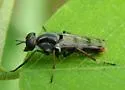
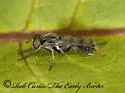
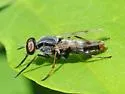
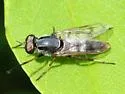
Photo credits: Contributed by john and jane balaban; Additional contributions by Robin McLeod , lee_penner
Frequently Asked Questions About Cerocatus rufiventris
What is Cerocatus rufiventris?
Cerocatus rufiventris is a species in the family Therevidae, within the order Diptera.
How big is Cerocatus rufiventris?
Female 7 to 9 mm., male 5.5 to 6.5 mm long.
How do you identify Cerocatus rufiventris?
| Feature | Details |
|---|---|
| Head | Black with silvery-white pile. Antenna: Yellowish-brown, last segment brown. 1st segment quite short, unusual for Cerocatus. |
| Thorax | Segment 1 (scutum) black with 2 gray pile longitudinal stripes, one each side of center. Segment 2 (scutellum) black, the base has a white line. Thorax side blue-gray pile. Wings: Clear, more whitish, with traces of 2 grayish crossbands, one near center of wing, one near tip. Male has faint spots (may be absent) in place of bands. Veins and stigma brown. |
| Legs | Blackish-brown. White pile on thighs (femora). Feet black. Hind foot 1st segment yellowish. |
| Abdomen | Female is reddish-orange, except segment 1 black with silver-gray pile. Base of all segments (incisures) dark. Tip has a yellowish circle of bristles. Underside reddish-orange. Male abdomen black; segments 1 to 3 covered with silvery-gray pile; 4 to 6 shiny black; tip reddish-yellow, hairy. |
Where is Cerocatus rufiventris found?
| Feature | Details |
|---|---|
| Habitat | Forest edges and meadows in sandy soils, dunes. |
| Range | U.S. except west coast; Ontario. |
What does Cerocatus rufiventris eat?
The diet of the Cerocatus rufiventris includes Generally this genus feeds on wireworms – click beetle larvae..
When is Cerocatus rufiventris active?
Cerocatus rufiventris: seasonal activity - June to August in the north, earlier in the south..