
Gopher Beetle
Ceratophyus gopherinus
This record describes Ceratophyus gopherinus (species). Recorded family: Geotrupidae. Recorded order: Coleoptera.
Identification and Appearance
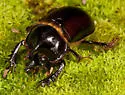
Information about parental care and larval food: Robert Duff, personal communication. Richter and Duff (1971) discuss the origin of this beetle in California: In 1962, a strange, deep burrowing, geotrupid beetle was found in Santa Barbara County, California, which could be of economic importance in golf courses and lawns (Anonymous, 1963). It was described as a new species of Ceratophyus by Cartwright in 1966. Ceratophyus is an old world genus occurring from Morocco and Southwestern Europe to Siberia, South Russia, and Sikkim (Cartwright, 1966). It seems probable, therefore, that Ceratophyus gopherinus is a species of foreign origin that was introduced into California some 10 years ago. However more recent opinion (Caterino, 2006) is that this is indeed a native species, endemic to California. M. Caterino notes that Cartwright 1966 originally thought it may have been introduced but it is very distinct from any known Old World Species and is currently considered the first confirmed native Geotrupinae in California.
Classification
- Kingdom
- Animalia
- Phylum
- Arthropoda
- Class
- Insecta
- Order
- Coleoptera (Beetles)
- Suborder
- Polyphaga
- Superfamily
- Scarabaeoidea
- Family
- Geotrupidae (Earth-Boring Scarab Beetles)
- Subfamily
- Geotrupinae
- Genus
- Ceratophyus
Imported taxonomy record. Source availability varies; see the source references and editorial policy below.
Habitat and Range
Geographic Range
Coastal California--originally thought to be adventive (Richter and Duff, 1971), but currently thought to be native (Caterino, 2006).
Seasonal Activity
Adults are active Jan. thru March and often found at temperatures near or below freezing.
Diet and Behavior
Life History
Noted for depositing large mounds of sand as the dig up to 10 feet below the ground surface. A single egg is laid at the end of the chamber where food is provided for the larvae. The food provided by the adults consists mainly of leaf litter. It consists mostly of leaves of Arctostapholos, Ceanothus, Adenostoma, and occasionally Rhus and Quercus. Seed pods were also deposited in the chamber. The chamber varies from 6 to 10 inches in length. It is not known if the larvae feed on the leaf litter, or on the mold that grows on the leaf litter (probably a little of both)
About Primitive Winged Insects: the wider group
Order-level background for Coleoptera, the group containing Ceratophyus gopherinus. Species-specific details appear above.
Group overview
Coleoptera is the largest order of insects with over 400,000 described species, representing ~25% of all known animal species and ~40% of all insects. In the U.S. alone, nearly 30,000 beetle species have been identified.
Ecological role of the group
Beetles are prominent decomposers, especially in forests, breaking down dead wood and recycling nutrients. As predators, they reduce populations of pest insects. Many species are also important pollinators of flowering plants.
Economic and practical significance of the group
Beetles have major economic significance: leaf beetles (Chrysomelidae) and weevils (Curculionoidea) are among the most destructive agricultural pests globally, costing billions annually, while predatory species like ladybugs provide natural pest control.
Recorded sources for this group: Britannica, Smithsonian, NCSU Entomology. Imported estimates may describe particular regions or reporting periods.
Photos of Gopher Beetle (5)
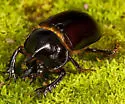
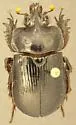
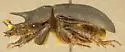
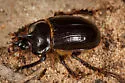
Photo credits: Contributed by Phillip Harpootlian; Additional contributions by cotinis , margarethe brummermann , Alice Abela , Blocky
Frequently Asked Questions About Gopher Beetle
What is Gopher Beetle?
Gopher Beetle (Ceratophyus gopherinus) is a species in the family Geotrupidae, within the order Coleoptera.
Where is Gopher Beetle found?
Range: Coastal California--originally thought to be adventive (Richter and Duff, 1971), but currently thought to be native (Caterino, 2006).
When is Gopher Beetle active?
Gopher Beetle: seasonal activity - Adults are active Jan. thru March and often found at temperatures near or below freezing..
What is the life cycle of a Gopher Beetle?
Noted for depositing large mounds of sand as the dig up to 10 feet below the ground surface. A single egg is laid at the end of the chamber where food is provided for the larvae. The food provided by the adults consists mainly of leaf litter. It consists mostly of leaves of Arctostapholos, Ceanothus, Adenostoma, and occasionally Rhus and Quercus. Seed pods were also deposited in the chamber. The chamber varies from 6 to 10 inches in length. It is not known if the larvae feed on the leaf litter, or on the mold that grows on the leaf litter (probably a little of both)