
Two-banded Ant-mimic
Castianeira cingulata
This record describes Castianeira cingulata (species). Recorded family: Corinnidae. Recorded order: Araneae.
Identification and Appearance
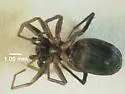
There are two forms of this spider Palp
Identification notes
There are two forms of this spider Palp
Classification
- Kingdom
- Animalia
- Phylum
- Arthropoda
- Class
- Arachnida
- Order
- Araneae (Spiders)
- Family
- Corinnidae (Antmimics and Ground Sac Spiders)
- Genus
- Castianeira
Imported taxonomy record. Source availability varies; see the source references and editorial policy below.
Habitat and Range
Geographic Range
This species can be found from Maine west to South Dakota and south to Kansas and Florida. The bicolored form is primarily found in the Upper Midwest where both forms can be found.
About Spiders: the wider group
Order-level background for Araneae, the group containing Castianeira cingulata. Species-specific details appear above.
Group overview
As of 2023, 51,673 spider species in 136 families have been recorded, though an estimated 150,000 species exist. Spiders rank 7th in total species diversity among all organism orders. Only 0.5% of spider species pose any risk to human health.
Ecological role of the group
Spider venom contains complex peptides with diverse pharmacological activities, making them valuable for drug development research. Spiders produce up to 7 types of silk from specialized glands. Spider silk genes have been inserted into mammals and plants for biotech applications.
Economic and practical significance of the group
The global spider community kills an estimated 400-800 million tons of prey annually (2017 study). Spiders provide billions of dollars in natural pest control for agriculture. Spider silk is 5× stronger than steel of the same diameter, driving a biomaterials research industry.
Recorded sources for this group: World Spider Catalog, PNAS, Nature, ScienceDirect. Imported estimates may describe particular regions or reporting periods.
Photos of Two-banded Ant-mimic (5)
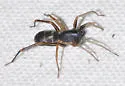
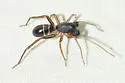
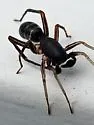
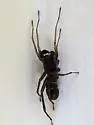
Photo credits: Contributed by john and jane balaban; Additional contributions by cotinis , Lynette Elliott , Jeff Hollenbeck , cheins , Chuck Entz , kschnei
Frequently Asked Questions About Two-banded Ant-mimic
What is Two-banded Ant-mimic?
Two-banded Ant-mimic (Castianeira cingulata) is a species in the family Corinnidae, within the order Araneae.
How do you identify Two-banded Ant-mimic?
There are two forms of this spider Palp
Where is Two-banded Ant-mimic found?
Range: This species can be found from Maine west to South Dakota and south to Kansas and Florida. The bicolored form is primarily found in the Upper Midwest where both forms can be found.