
Arctic Skipper - Hodges#3982
Carterocephalus mandan
This record describes Carterocephalus mandan (species). Recorded family: Hesperiidae. Recorded order: Lepidoptera.
Identification and Appearance
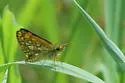
Adult: upperside black with squarish orange spots; underside of forewing orange with black spots; underside of hindwing red-orange with cream spots outlined in black Larva: cream-coloured with faint dorsal stripe and yellowish lateral line above row of black spots Considered high priority conservation in Europe.
Classification
- Kingdom
- Animalia
- Phylum
- Arthropoda
- Class
- Insecta
- Order
- Lepidoptera (Butterflies and Moths)
- Superfamily
- Papilionoidea
- Family
- Hesperiidae (Skippers)
- Subfamily
- Heteropterinae
- Genus
- Carterocephalus
Imported taxonomy record. Source availability varies; see the source references and editorial policy below.
Habitat and Range
Habitat
Glades and openings in heavily forested woods, moist meadows, and streamsides.
Geographic Range
Type Locality: Manitoba.
Seasonal Activity
One brood from May-July.
Diet and Behavior
Diet: Larva: Grasses, including purple reedgrass ( Calamagrostis purpurascens ) in California. Adults: Nectar from flowers, including Iris in California.
Life History
Adults rest with their wings closed, but bask with hindwings open wide and forewings open to about 45 degrees. To find receptive females, males perch on low vegetation and sometimes patrol in openings. Females lay eggs singly on leaves of the host plant. Caterpillars live and feed within nests of silked-together leaves; fully-grown caterpillars overwinter in their nests and then pupate within them in the spring.
Additional species information
Species notes from the sources
Etymology: Carterocephalus mandan (Edwards, 1863), formerly treated as a subspecies of Papilio palaemon Pallas, 1771, is raised to full species with mesapano Scudder, 1868 as a subspecies in Zhang et al. . C. palaemon (Pallas, 1771) is now considered extralimital to North America. The name Arctic Skipper is misleading as it is not found in the Arctic, and is most common in the Boreal and Mixed Deciduous Woodland Zones on the margins of deciduous forests.
About Butterflies and Moths: the wider group
Order-level background for Lepidoptera, the group containing Carterocephalus mandan. Species-specific details appear above.
Group overview
Lepidoptera includes approximately 180,000 described species of butterflies and moths. Moths outnumber butterflies roughly 10:1. The monarch butterfly's eastern population has declined by more than 80% since the mid-1990s, and the western population by over 95% since the 1980s. The IUCN lists the migratory monarch as Vulnerable.
Ecological role of the group
Butterflies and moths are essential indicators of ecosystem health. As caterpillars, they are a primary food source for birds - a single nest of blue tit chicks requires ~10,000 caterpillars. Adult moths pollinate many night-blooming plants.
Economic and practical significance of the group
Lepidoptera are critical pollinators. In Europe, grassland butterfly species have declined by almost 50% since the early 1990s. In the UK, three-quarters of butterflies are in decline. In the U.S., five butterfly species have gone extinct since 1950, with 29 listed as endangered.
Recorded sources for this group: IUCN Red List, Xerces Society, USFWS, PNAS, WWF. Imported estimates may describe particular regions or reporting periods.
Photos of Arctic Skipper - Hodges#3982 (5)
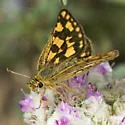
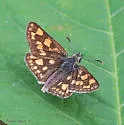
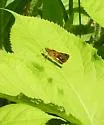
Photo credits: Contributed by Joel Kits; Additional contributions by Steve Nanz , Robin McLeod , Jason D. Roberts
Frequently Asked Questions About Arctic Skipper - Hodges#3982
What is Arctic Skipper - Hodges#3982?
Arctic Skipper - Hodges#3982 (Carterocephalus mandan) is a species in the family Hesperiidae, within the order Lepidoptera.
How big is Arctic Skipper - Hodges#3982?
wingspan 19-32 mm
How do you identify Arctic Skipper - Hodges#3982?
Adult: upperside black with squarish orange spots; underside of forewing orange with black spots; underside of hindwing red-orange with cream spots outlined in black Larva: cream-coloured with faint dorsal stripe and yellowish lateral line above row of black spots
Where is Arctic Skipper - Hodges#3982 found?
| Feature | Details |
|---|---|
| Habitat | Glades and openings in heavily forested woods, moist meadows, and streamsides. |
| Range | Type Locality: Manitoba. |
What does Arctic Skipper - Hodges#3982 eat?
The diet of the Arctic Skipper - Hodges#3982 includes Larva: Grasses, including purple reedgrass ( Calamagrostis purpurascens ) in California. Adults: Nectar from flowers, including Iris in California..
When is Arctic Skipper - Hodges#3982 active?
Arctic Skipper - Hodges#3982: seasonal activity - One brood from May-July..
What is the life cycle of a Arctic Skipper - Hodges#3982?
Adults rest with their wings closed, but bask with hindwings open wide and forewings open to about 45 degrees. To find receptive females, males perch on low vegetation and sometimes patrol in openings. Females lay eggs singly on leaves of the host plant. Caterpillars live and feed within nests of silked-together leaves; fully-grown caterpillars overwinter in their nests and then pupate within them in the spring.