
Pear Slug Sawfly
Caliroa cerasi
This record describes Caliroa cerasi (species). Recorded family: Tenthredinidae. Recorded order: Hymenoptera.
Identification and Appearance
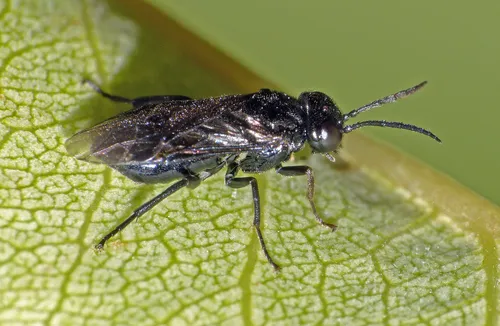
larvae feed on upper surface of leaves producing distinctive skeletonizing wounds ( 7 )
Wikipedia reference for Caliroa cerasi: http://en.wikipedia.org/wiki/Pear_slug.
Classification
- Kingdom
- Animalia
- Phylum
- Arthropoda
- Class
- Insecta
- Order
- Hymenoptera (Ants, Bees, Wasps and Sawflies)
- Family
- Tenthredinidae (Common Sawflies)
- Subfamily
- Heterarthrinae
- Tribe
- Caliroini
- Genus
- Caliroa
Imported taxonomy record. Source availability varies; see the source references and editorial policy below.
Habitat and Range
Geographic Range
Native to Europe & w. Asia, adventive on all other continents ; in NA, widespread, mostly in n. US and so. Canada ( map )
Seasonal Activity
In Canada adults emerge and fly in mid-June to late July, elsewhere as early as mid-May ( 5 )
Diet and Behavior
Diet: polyphagous on Rosaceae ( 3 )
Life History
Parthenogenetic (males unknown in NA, rare in Europe), usually bivoltine in NA Overwinter in earthen cells or cocoons made of grains of soil held together by a substance secreted by the larva. Pupation in June. Eggs laid singly in semi-circular slits cut in the leaf tissue. Larvae eat the parenchyma only. Full-grown larvae drop to the ground and form cells in soil for pupation. Two generations per year.
Additional species information
Species notes from the sources
Etymology: Caliroa cerasi (Linnaeus 1758)
About Flies: the wider group
Order-level background for Hymenoptera, the group containing Caliroa cerasi. Species-specific details appear above.
Group overview
Hymenoptera includes over 150,000 described species of ants, bees, wasps, and sawflies. Earth harbors approximately 20 quadrillion (20×10^15) ants, with a combined biomass of ~12 megatons of dry carbon - exceeding the combined biomass of all wild birds and mammals (PNAS, 2022).
Ecological role of the group
About 35% of the world's food crops depend on animal pollinators. The chocolate industry, valued at over $100 billion, depends on pollinating flies and midges. Ants are the dominant soil engineers in most terrestrial ecosystems, turning more soil than earthworms in many habitats.
Economic and practical significance of the group
Pollinators contribute $235-577 billion worth of annual global food production (FAO). In the U.S., bee pollination alone benefits crops valued at $18 billion annually, and honey bees are responsible for $5.4 billion in agricultural productivity. Between April 2023-2024, 55.1% of managed honey bee colonies were lost. The U.S. bee population dropped from 5 million to 2.5 million.
Recorded sources for this group: FAO, USDA, EPA, PNAS (2022), US Fish & Wildlife Service. Imported estimates may describe particular regions or reporting periods.
Photos of Pear Slug Sawfly (2)
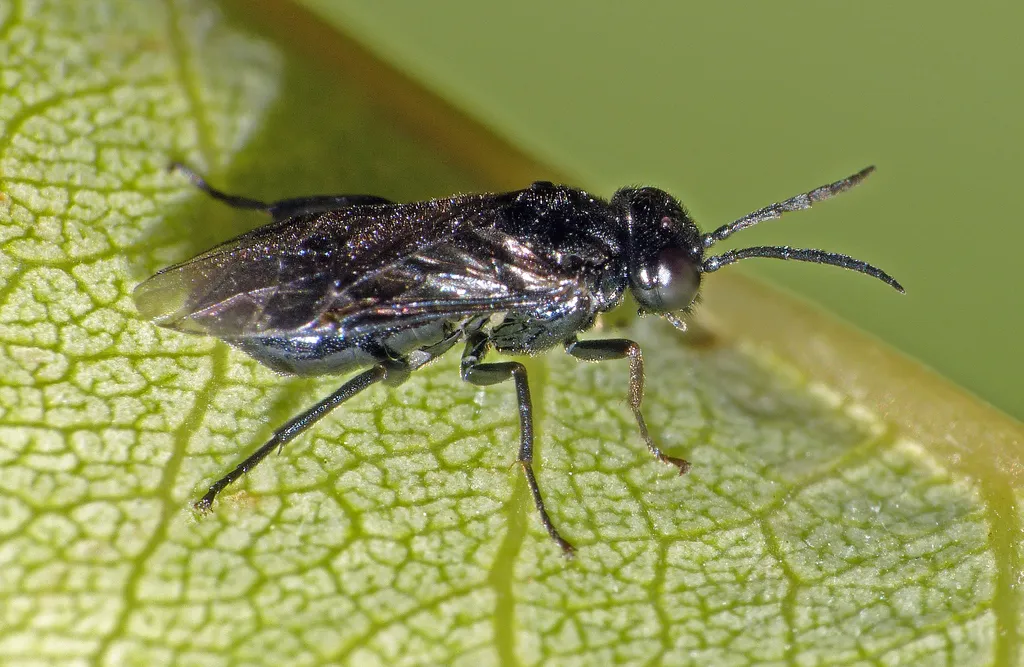
Photo credits: Contributed by Eric R. Eaton; Additional contributions by Beatriz Moisset , ceiseman , v belov , Marci Hess , PaleoJon
Frequently Asked Questions About Pear Slug Sawfly
What is Pear Slug Sawfly?
Pear Slug Sawfly (Caliroa cerasi) is a species in the family Tenthredinidae, within the order Hymenoptera.
How big is Pear Slug Sawfly?
adult 4‒6 mm, larva up to 11 mm
Where is Pear Slug Sawfly found?
Range: Native to Europe & w. Asia, adventive on all other continents ; in NA, widespread, mostly in n. US and so. Canada ( map )
What does Pear Slug Sawfly eat?
The diet of the Pear Slug Sawfly includes polyphagous on Rosaceae ( 3 ).
When is Pear Slug Sawfly active?
Pear Slug Sawfly: seasonal activity - In Canada adults emerge and fly in mid-June to late July, elsewhere as early as mid-May ( 5 ).
What is the life cycle of a Pear Slug Sawfly?
Parthenogenetic (males unknown in NA, rare in Europe), usually bivoltine in NA Overwinter in earthen cells or cocoons made of grains of soil held together by a substance secreted by the larva. Pupation in June. Eggs laid singly in semi-circular slits cut in the leaf tissue. Larvae eat the parenchyma only. Full-grown larvae drop to the ground and form cells in soil for pupation. Two generations per year.