
Caccodes granicollis
This record describes Caccodes granicollis (species). Recorded family: Cantharidae. Recorded order: Coleoptera.
Identification and Appearance
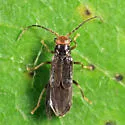
See detailed comments under this image: Quoting the original description: Head dark orange with a brunneous interocular fascia behind the antennae, antennae piceous with the basal segment paler at the basal half; pronotum brunneous with slightly paler mediolateral areas; elytra and the body beneath piceous; legs testaceous with the apices of all tibiae widely and the middle of the femora infuscate, more widely so on the hind legs; pubescence cinereous, moderately conspicuous. Length 3 mm. Male: Head rounded, flat just behind the antennae to behind the eyes then curved into the neck which is stout, finely, closely punctured in front, sparsely so behind the antennae and to the neck which is finely closely granulate; eyes small and moderately prominent; antennae moderately stout, segments two to four progressively longer, the intermediate segments about three and a half times as long as wide; pronotum strongly transverse, not constricted anteriorly, the anterior angles rounded, the sides feebly sinuate and subparallel to the hind angles which are obtuse, marginal bead thick, disc finely closely granulose; elytra short, about two and a half times the length of the pronotum, finely sparsely confused punctate basally, becoming rugose apically; seventh ventral ovate, the apex deeply notched. Female: Similar to the male but the pronotal disc less closely granulose. There seems to be a bit of confusion about formatting of this author's name among various sources. If one looks at the original references, the author of this taxon is Kenneth M. Fender. His spouse, Dorothy McKey-Fender (nee McKey obviously) also worked on Cantharidae. ITIS credits her as the author of this taxon, but that appears to be an error. See discussion in the editor's forum.
Classification
- Kingdom
- Animalia
- Phylum
- Arthropoda
- Class
- Insecta
- Order
- Coleoptera (Beetles)
- Suborder
- Polyphaga
- Superfamily
- Elateroidea
- Family
- Cantharidae (Soldier Beetles)
- Subfamily
- Malthininae
- Tribe
- Malthinini
- Genus
- Caccodes
Imported taxonomy record. Source availability varies; see the source references and editorial policy below.
Habitat and Range
Geographic Range
Includes Atlantic Seaboard of the United States: Maryland, North Carolina (Fender, 1951)
About Primitive Winged Insects: the wider group
Order-level background for Coleoptera, the group containing Caccodes granicollis. Species-specific details appear above.
Group overview
Coleoptera is the largest order of insects with over 400,000 described species, representing ~25% of all known animal species and ~40% of all insects. In the U.S. alone, nearly 30,000 beetle species have been identified.
Ecological role of the group
Beetles are prominent decomposers, especially in forests, breaking down dead wood and recycling nutrients. As predators, they reduce populations of pest insects. Many species are also important pollinators of flowering plants.
Economic and practical significance of the group
Beetles have major economic significance: leaf beetles (Chrysomelidae) and weevils (Curculionoidea) are among the most destructive agricultural pests globally, costing billions annually, while predatory species like ladybugs provide natural pest control.
Recorded sources for this group: Britannica, Smithsonian, NCSU Entomology. Imported estimates may describe particular regions or reporting periods.
Photos of Caccodes granicollis (5)
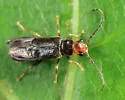
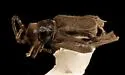
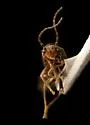
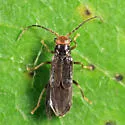
Photo credits: Contributed by tom murray; Additional contributions by cotinis
Frequently Asked Questions About Caccodes granicollis
What is Caccodes granicollis?
Caccodes granicollis is a species in the family Cantharidae, within the order Coleoptera.
How big is Caccodes granicollis?
3 mm (Fender, 1951)
How do you identify Caccodes granicollis?
See detailed comments under this image: Quoting the original description: Head dark orange with a brunneous interocular fascia behind the antennae, antennae piceous with the basal segment paler at the basal half; pronotum brunneous with slightly paler mediolateral areas; elytra and the body beneath piceous; legs testaceous with the apices of all tibiae widely and the middle of the femora infuscate, more widely so on the hind legs; pubescence cinereous, moderately conspicuous. Length 3 mm. Male: Head rounded, flat just behind the antennae to behind the eyes then curved into the neck which is stout, finely, closely punctured in front, sparsely so behind the antennae and to the neck which is finely closely granulate; eyes small and moderately prominent; antennae moderately stout, segments two to four progressively longer, the intermediate segments about three and a half times as long as wide; pronotum strongly transverse, not constricted anteriorly, the anterior angles rounded, the sides feebly sinuate and subparallel to the hind angles which are obtuse, marginal bead thick, disc finely closely granulose; elytra short, about two and a half times the length of the pronotum, finely sparsely confused punctate basally, becoming rugose apically; seventh ventral ovate, the apex deeply notched. Female: Similar to the male but the pronotal disc less closely granulose.
Where is Caccodes granicollis found?
Range: Includes Atlantic Seaboard of the United States: Maryland, North Carolina (Fender, 1951)