
Brunner's Mantis
Brunneria borealis
This record describes Brunneria borealis (species). Recorded family: Coptopterygidae. Recorded order: Mantodea.
Identification and Appearance
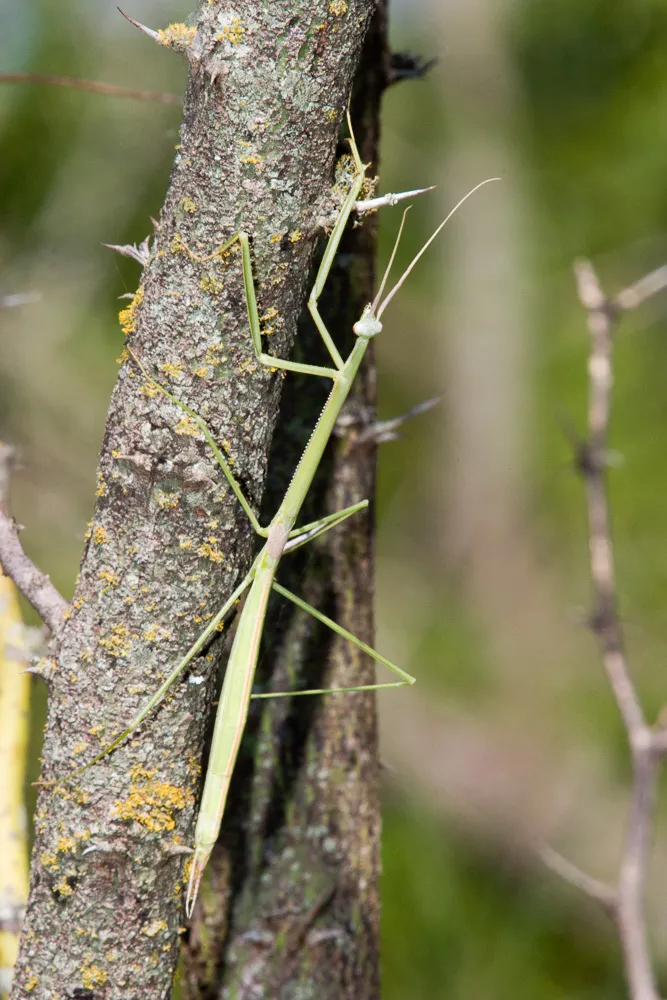
| Feature | Description |
|---|---|
| Additional details | From genus description: Very slender, much resembling a Walkingstick. Our species with very short wings. |
| Pronotum | Pronotum with prothorax approximately 3 times the length of remainder of thorax, and with portion of pronotum in front of front legs more than twice as long as portion behind front legs. Lateral margins of thorax (?always) serrate. |
| Head | Head tends to be carried with mouth pointing frontward, instead of the more usual downward seen in most Mantids. |
| Antennae | Antennae gradually widened toward base, shorter than thorax (except in young nymphs, and in those only a little longer than thorax). Color varies from green through shades of greenish or pinkish to grey or brown. Similar to Grass Mantid , but has distinctive fine serrations along sides of thorax, is larger, and reproduces by parthenogenesis ; males are unknown. Thick antennal base characterizes this species. |
| Wings | Wings reduced--flightless. |
Wikipedia reference for Brunneria borealis: http://en.wikipedia.org/wiki/Brunneria_borealis.
Classification
- Kingdom
- Animalia
- Phylum
- Arthropoda
- Class
- Insecta
- Order
- Mantodea (Mantids)
- Family
- Coptopterygidae
- Genus
- Brunneria (Brunner's Stick Mantis)
Imported taxonomy record. Source availability varies; see the source references and editorial policy below.
Habitat and Range
Habitat
Meadows with tall grass, especially Little Bluestem ( Schizachyrium scoparium )
Geographic Range
se US (NC-FL-TX) to Mexico
Seasonal Activity
Sep-Oct in NC
Diet and Behavior
Diet: Orthoptera reported to be prey of preference . Prey records on BugGuide include itself (cannibalism), Diptera ( Plecia ), Diptera ( Plecia ), and Lepidoptera .
About Mantids: the wider group
Order-level background for Mantodea, the group containing Brunneria borealis. Species-specific details appear above.
Group overview
Mantodea (praying mantises) includes ~2,400 described species in 430 genera. The praying mantis is the only insect that can turn its head 180 degrees to look over its shoulder.
Ecological role of the group
Mantises are apex insect predators with lightning-fast strike speeds - they can catch prey in as little as 50-70 milliseconds. Some species catch hummingbirds and small lizards. Female mantises sometimes practice sexual cannibalism, consuming the male during or after mating in about 25% of encounters.
Economic and practical significance of the group
Mantises are sold commercially as garden pest control. The Chinese mantis (Tenodera sinensis) was introduced to the U.S. in 1896 for pest control and is now established across the eastern United States.
Recorded sources for this group: Smithsonian, entomology research. Imported estimates may describe particular regions or reporting periods.
Photos of Brunner's Mantis (2)
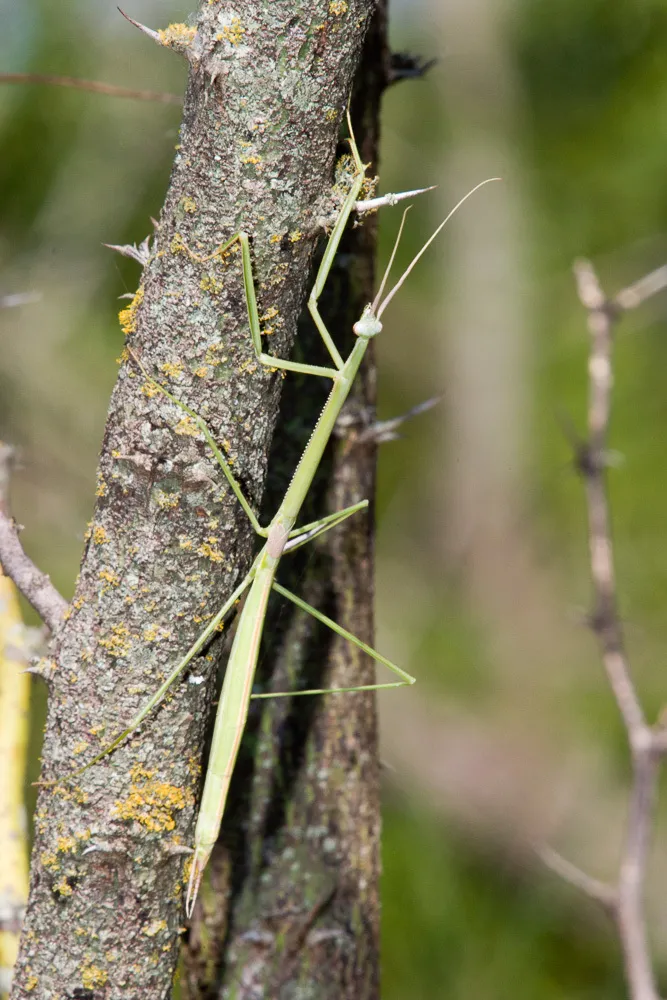
Photo credits: Contributed by Jim McClarin; Additional contributions by Troy Bartlett , cotinis , Chuck Entz , David Ferguson , v belov
Frequently Asked Questions About Brunner's Mantis
What is Brunner's Mantis?
Brunner's Mantis (Brunneria borealis) is a species in the family Coptopterygidae, within the order Mantodea.
How big is Brunner's Mantis?
65-90 mm
How do you identify Brunner's Mantis?
| Feature | Description |
|---|---|
| Additional details | From genus description: Very slender, much resembling a Walkingstick. Our species with very short wings. |
| Pronotum | Pronotum with prothorax approximately 3 times the length of remainder of thorax, and with portion of pronotum in front of front legs more than twice as long as portion behind front legs. Lateral margins of thorax (?always) serrate. |
| Head | Head tends to be carried with mouth pointing frontward, instead of the more usual downward seen in most Mantids. |
| Antennae | Antennae gradually widened toward base, shorter than thorax (except in young nymphs, and in those only a little longer than thorax). Color varies from green through shades of greenish or pinkish to grey or brown. Similar to Grass Mantid , but has distinctive fine serrations along sides of thorax, is larger, and reproduces by parthenogenesis ; males are unknown. Thick antennal base characterizes this species. |
| Wings | Wings reduced--flightless. |
Where is Brunner's Mantis found?
| Feature | Details |
|---|---|
| Habitat | Meadows with tall grass, especially Little Bluestem ( Schizachyrium scoparium ) |
| Range | se US (NC-FL-TX) to Mexico |
What does Brunner's Mantis eat?
The diet of the Brunner's Mantis includes Orthoptera reported to be prey of preference . Prey records on BugGuide include itself (cannibalism), Diptera ( Plecia ), Diptera ( Plecia ), and Lepidoptera ..
When is Brunner's Mantis active?
Brunner's Mantis: seasonal activity - Sep-Oct in NC.