
Mexican Metalmark - Hodges#4402.2
Apodemia mejicanus
This record describes Apodemia mejicanus (species). Recorded family: Riodinidae. Recorded order: Lepidoptera.
Identification and Appearance
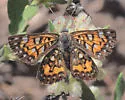
Distinguished from A. mormo by more easterly and southerly distribution (but overlapping widely), and by the red/orange coloring which forms a band through the middle of the wings above and includes or replaces most of the white median spot band on the hind wing. Not reliably distinguishable from A. virgulti except by location. A member of the Apodemia mormo complex or superspecies, of which members are all considered as a single variable species by some authors, while other authors recognize varied numbers of distinct species. Certain types that look different may coexist in the same location and remain distinct [i.e. mormo and mejicanus ], which implies that in those areas there are at least two species. Relationships between various populations are still being sorted out. A. duryi appears to be just a southern subspecies of A. mejicanus as evidenced by intermediate specimens found where they meet, but this question needs more study. The two are left separate here for now.
Classification
- Kingdom
- Animalia
- Phylum
- Arthropoda
- Class
- Insecta
- Order
- Lepidoptera (Butterflies and Moths)
- Superfamily
- Papilionoidea
- Family
- Riodinidae (Metalmarks)
- Subfamily
- Riodininae
- Tribe
- Emesidini
- Genus
- Apodemia
Imported taxonomy record. Source availability varies; see the source references and editorial policy below.
Habitat and Range
Habitat
Open sunny areas where host plants grow; usually gravelly to rocky and usually in mountains, canyons or other broken terrain; from deserts up into openings of Montane woodlands.
Geographic Range
From se. Wyoming southward along the east side of the Southern Rockies into northern Mexico, and westward across New Mexico and Chihuahua into Arizona, Sonora, Sinaloa, & Baja California Sur. Reported from Dakotas and Montana (perhaps misidentifications?).
Seasonal Activity
Adult flight varies with regional climate and rainfall patterns. Mostly one brood in north, in June, July or August. Mostly one or two flights in south (sometimes three), depending on elevation, rains, etc. Most areas with a strong spring flight about April or May, with often another in August or September depending upon the season. Some areas usually autumn and less often in spring. Sometimes seen as early as February and as late as November.
Diet and Behavior
Diet: Larval host - Eriogonum species [ Krameria glandulosa is also reported]. Adults use many plants for nectar, but favor Eriogonum species as well.
About Butterflies and Moths: the wider group
Order-level background for Lepidoptera, the group containing Apodemia mejicanus. Species-specific details appear above.
Group overview
Lepidoptera includes approximately 180,000 described species of butterflies and moths. Moths outnumber butterflies roughly 10:1. The monarch butterfly's eastern population has declined by more than 80% since the mid-1990s, and the western population by over 95% since the 1980s. The IUCN lists the migratory monarch as Vulnerable.
Ecological role of the group
Butterflies and moths are essential indicators of ecosystem health. As caterpillars, they are a primary food source for birds - a single nest of blue tit chicks requires ~10,000 caterpillars. Adult moths pollinate many night-blooming plants.
Economic and practical significance of the group
Lepidoptera are critical pollinators. In Europe, grassland butterfly species have declined by almost 50% since the early 1990s. In the UK, three-quarters of butterflies are in decline. In the U.S., five butterfly species have gone extinct since 1950, with 29 listed as endangered.
Recorded sources for this group: IUCN Red List, Xerces Society, USFWS, PNAS, WWF. Imported estimates may describe particular regions or reporting periods.
Photos of Mexican Metalmark - Hodges#4402.2 (5)
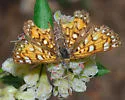
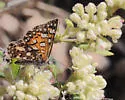
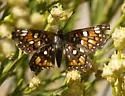
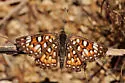
Photo credits: Contributed by David J. Ferguson; Additional contributions by Steve Nanz
Frequently Asked Questions About Mexican Metalmark - Hodges#4402.2
What is Mexican Metalmark - Hodges#4402.2?
Mexican Metalmark - Hodges#4402.2 (Apodemia mejicanus) is a species in the family Riodinidae, within the order Lepidoptera.
How do you identify Mexican Metalmark - Hodges#4402.2?
Distinguished from A. mormo by more easterly and southerly distribution (but overlapping widely), and by the red/orange coloring which forms a band through the middle of the wings above and includes or replaces most of the white median spot band on the hind wing. Not reliably distinguishable from A. virgulti except by location.
Where is Mexican Metalmark - Hodges#4402.2 found?
| Feature | Details |
|---|---|
| Habitat | Open sunny areas where host plants grow; usually gravelly to rocky and usually in mountains, canyons or other broken terrain; from deserts up into openings of Montane woodlands. |
| Range | From se. Wyoming southward along the east side of the Southern Rockies into northern Mexico, and westward across New Mexico and Chihuahua into Arizona, Sonora, Sinaloa, & Baja California Sur. Reported from Dakotas and Montana (perhaps misidentifications?). |
What does Mexican Metalmark - Hodges#4402.2 eat?
The diet of the Mexican Metalmark - Hodges#4402.2 includes Larval host - Eriogonum species [ Krameria glandulosa is also reported]. Adults use many plants for nectar, but favor Eriogonum species as well..
When is Mexican Metalmark - Hodges#4402.2 active?
Mexican Metalmark - Hodges#4402.2: seasonal activity - Adult flight varies with regional climate and rainfall patterns. Mostly one brood in north, in June, July or August. Mostly one or two flights in south (sometimes three), depending on elevation, rains, etc. Most areas with a strong spring flight about April or May, with often another in August or September depending upon the season. Some areas usually autumn and less often in spring. Sometimes seen as early as February and as late as November..