
Aphalara persicaria
This record describes Aphalara persicaria (species). Recorded family: Aphalaridae. Recorded order: Hemiptera.
Identification and Appearance
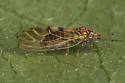
General color red-brown to orange with four light yellow stripes on the scutum, abdomen darker; forewings hyaline, sometimes with a suggestion of fumation apically, marginal termination of all veins darkened, a black spot present at termination of vein Cu1a. Male forceps somewhat rectangular, female genital segment with dorsal valve sinuate terminating at a nose-like apex Prior to 1937 many of the North American Aphalara were treated, incorrectly, as A. calthae , before Caldwell determined that A. calthae was palearctic and the North American specimens belonged to a complex of closely-related species. Not much work has been done on this complex since then, and the ranges of these species are probably much broader than published records imply. Moreover the hostplant is an introduced species, so this may very well have been introduced with it.
Classification
- Kingdom
- Animalia
- Phylum
- Arthropoda
- Class
- Insecta
- Order
- Hemiptera (True Bugs, Cicadas, Hoppers, Aphids and Allies)
- Suborder
- Sternorrhyncha
- Superfamily
- Psylloidea
- Family
- Aphalaridae
- Subfamily
- Aphalarinae
- Genus
- Aphalara
Imported taxonomy record. Source availability varies; see the source references and editorial policy below.
Habitat and Range
Geographic Range
Described from Ohio ; also known from Cuba
Seasonal Activity
Adults have been observed from late June to September in Ohio
Diet and Behavior
Diet: The non-native species Polygonum persicaria (Spotted Ladysthumb)
Life History
Nymphs develop in curled leaves where they produce large amounts of honeydew and wax. There are at least three generations in Ohio
Additional species information
Species notes from the sources
Etymology: Aphalara persicaria Caldwell, 1937
About True Bugs, Cicadas, Hoppers, Aphids and Allies: the wider group
Order-level background for Hemiptera, the group containing Aphalara persicaria. Species-specific details appear above.
Group overview
Hemiptera (true bugs) includes over 80,000 described species across cicadas, aphids, leafhoppers, shield bugs, and bed bugs. Aphids alone cost global agriculture an estimated $2.5 billion annually in crop losses.
Ecological role of the group
Many Hemiptera are essential food sources for birds and predatory insects. Cicadas provide massive nutrient pulses during emergence events - a single Brood X emergence can involve trillions of individuals across 15 states.
Economic and practical significance of the group
The brown marmorated stink bug (Halyomorpha halys) caused $37 million in apple crop losses in a single year in the U.S. Mid-Atlantic region. Bed bug infestations in the U.S. increased by 500% between 2001-2010, costing the hotel industry hundreds of millions annually.
Recorded sources for this group: USDA, EPA, University research. Imported estimates may describe particular regions or reporting periods.
Frequently Asked Questions About Aphalara persicaria
What is Aphalara persicaria?
Aphalara persicaria is a species in the family Aphalaridae, within the order Hemiptera.
How big is Aphalara persicaria?
2.5 - 3.25mm
How do you identify Aphalara persicaria?
General color red-brown to orange with four light yellow stripes on the scutum, abdomen darker; forewings hyaline, sometimes with a suggestion of fumation apically, marginal termination of all veins darkened, a black spot present at termination of vein Cu1a. Male forceps somewhat rectangular, female genital segment with dorsal valve sinuate terminating at a nose-like apex
Where is Aphalara persicaria found?
Range: Described from Ohio ; also known from Cuba
What does Aphalara persicaria eat?
The diet of the Aphalara persicaria includes The non-native species Polygonum persicaria (Spotted Ladysthumb).
When is Aphalara persicaria active?
Aphalara persicaria: seasonal activity - Adults have been observed from late June to September in Ohio.
What is the life cycle of a Aphalara persicaria?
Nymphs develop in curled leaves where they produce large amounts of honeydew and wax. There are at least three generations in Ohio