
Sara Orangetip - Hodges#4206
Anthocharis sara
This record describes Anthocharis sara (species). Recorded family: Pieridae. Recorded order: Lepidoptera.
Identification and Appearance
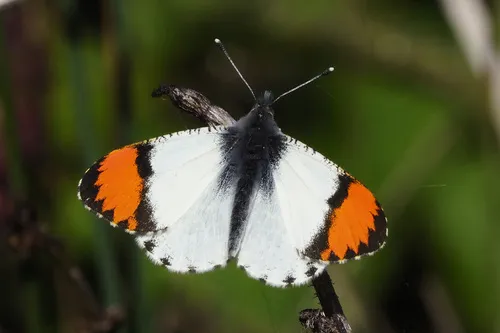
Where found in the same areas as 'Desert Orangetip' ( Anthocharis cethura ), that species has prominent pale (usually white) spots along the margin of the upper front wing, clearly dividing the dark border from the edge of the wing, while in A. sara such spots are narrow (i.e. in many females) or barely evident at all, and the dark border right along the edge. On the under side A. cethura has the greenish marbling on the hind wing merged onto relatively broad well-defined bands, while in A. sara the marbling is finer and more evenly spread across the wing (and in the area where the species are together, usually less greenish). In A. cethura the males in commonly decidedly yellowish, and always so in many populations; while in A. sara , yellow males are rare.
Classification
- Kingdom
- Animalia
- Phylum
- Arthropoda
- Class
- Insecta
- Order
- Lepidoptera (Butterflies and Moths)
- Superfamily
- Papilionoidea
- Family
- Pieridae (Whites, Sulphurs, Yellows)
- Subfamily
- Pierinae
- Tribe
- Anthocharidini
- Genus
- Anthocharis (Orangetips)
Imported taxonomy record. Source availability varies; see the source references and editorial policy below.
Habitat and Range
Habitat
Varied, mostly found in areas of broken terrain, often in canyons, open woodlands, and riparian areas.
Geographic Range
Oregon to Baja Mexico.
Seasonal Activity
Late winter through sping, with timing depending primarily on elevation and latitude. One brood in most regions, but sometimes apparently with two flights near southern Pacific coast (probably not two broods, but more likely with some emerging early and others delayed; perhaps depending on rains and temperatures?).
Diet and Behavior
Life History
Larvae feed on mustard family (Brassicaceae), esp. Tower Mustard, Arabis glabra.
Additional species information
Species notes from the sources
Etymology: The Anthocharis sara complex was revised in Stout . Three species and fifteen subspecies are now recognized as follows: • Anthocharis sara Lucas, 1852 A. s. gunderi (Ingham, 1933) A. s. pseudothoosa (Austin, 1998) A. s. sara (Lucas, 1852) A. s. sempervirens (Emmel, Emmel & Mattoon, 2008) • Anthocharis julia Edwards, 1872 A. j. alaskensis (Gunder, 1932) A. j. browningi (Skinner, 1906) A. j. flora (Wright, 1892) A. j. julia (Edwards, 1872) A. j. prestonorum (Stout, 2012) A. j. stella (Edwards, 1879) A. j. sulfuris (Pelham, 2008) • Anthocharis thoosa (Scudder, 1878) A. t. colorado (Scott & Fisher, 2008) A. t. corcorani (Gunder, 1931) A. t. inghami (Gunder, 1932) A. t. thoosa (Scudder, 1878)
About Butterflies and Moths: the wider group
Order-level background for Lepidoptera, the group containing Anthocharis sara. Species-specific details appear above.
Group overview
Lepidoptera includes approximately 180,000 described species of butterflies and moths. Moths outnumber butterflies roughly 10:1. The monarch butterfly's eastern population has declined by more than 80% since the mid-1990s, and the western population by over 95% since the 1980s. The IUCN lists the migratory monarch as Vulnerable.
Ecological role of the group
Butterflies and moths are essential indicators of ecosystem health. As caterpillars, they are a primary food source for birds - a single nest of blue tit chicks requires ~10,000 caterpillars. Adult moths pollinate many night-blooming plants.
Economic and practical significance of the group
Lepidoptera are critical pollinators. In Europe, grassland butterfly species have declined by almost 50% since the early 1990s. In the UK, three-quarters of butterflies are in decline. In the U.S., five butterfly species have gone extinct since 1950, with 29 listed as endangered.
Recorded sources for this group: IUCN Red List, Xerces Society, USFWS, PNAS, WWF. Imported estimates may describe particular regions or reporting periods.
Photos of Sara Orangetip - Hodges#4206 (2)
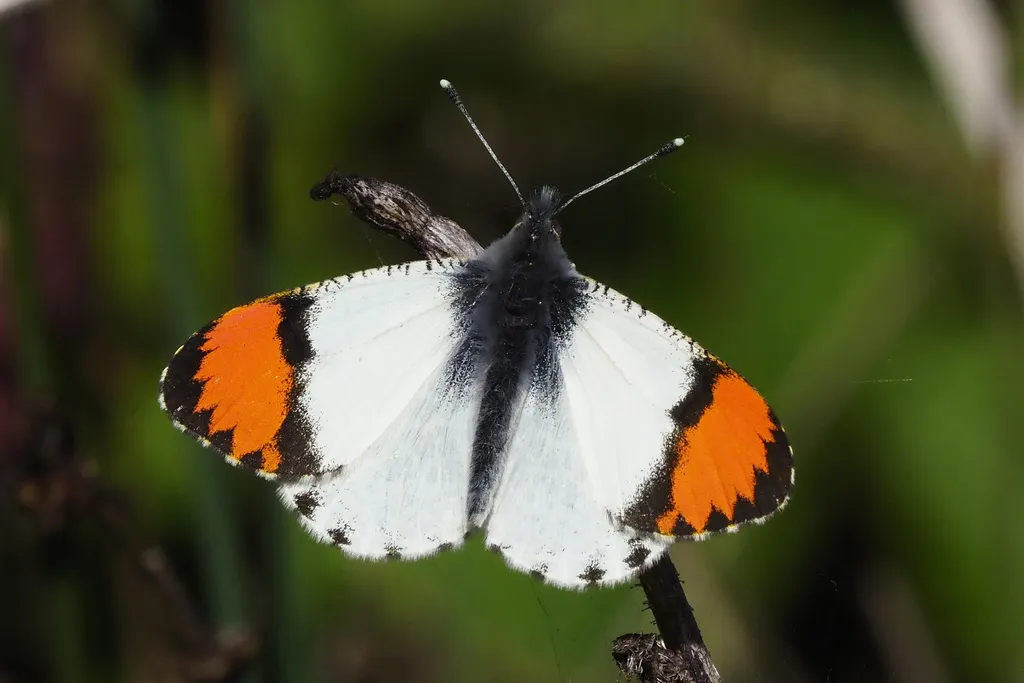
Photo credits: Contributed by Cotinis; Additional contributions by john and jane balaban , Steve Nanz , Hartmut Wisch , Chuck Entz , David Ferguson
Frequently Asked Questions About Sara Orangetip - Hodges#4206
What is Sara Orangetip - Hodges#4206?
Sara Orangetip - Hodges#4206 (Anthocharis sara) is a species in the family Pieridae, within the order Lepidoptera.
How big is Sara Orangetip - Hodges#4206?
Wingspan 2.7-4 cm
How do you identify Sara Orangetip - Hodges#4206?
Where found in the same areas as 'Desert Orangetip' ( Anthocharis cethura ), that species has prominent pale (usually white) spots along the margin of the upper front wing, clearly dividing the dark border from the edge of the wing, while in A. sara such spots are narrow (i.e. in many females) or barely evident at all, and the dark border right along the edge. On the under side A. cethura has the greenish marbling on the hind wing merged onto relatively broad well-defined bands, while in A. sara the marbling is finer and more evenly spread across the wing (and in the area where the species are together, usually less greenish). In A. cethura the males in commonly decidedly yellowish, and always so in many populations; while in A. sara , yellow males are rare.
Where is Sara Orangetip - Hodges#4206 found?
| Feature | Details |
|---|---|
| Habitat | Varied, mostly found in areas of broken terrain, often in canyons, open woodlands, and riparian areas. |
| Range | Oregon to Baja Mexico. |
When is Sara Orangetip - Hodges#4206 active?
Sara Orangetip - Hodges#4206: seasonal activity - Late winter through sping, with timing depending primarily on elevation and latitude. One brood in most regions, but sometimes apparently with two flights near southern Pacific coast (probably not two broods, but more likely with some emerging early and others delayed; perhaps depending on rains and temperatures?)..
What is the life cycle of a Sara Orangetip - Hodges#4206?
Larvae feed on mustard family (Brassicaceae), esp. Tower Mustard, Arabis glabra.