
Anisocentropus pyraloides
This record describes Anisocentropus pyraloides (species). Recorded family: Calamoceratidae. Recorded order: Trichoptera.
Identification and Appearance
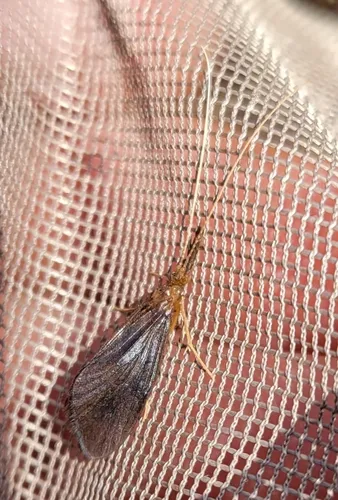
Larvae and pupae described by Wallace and Sherberger (1970). Adults are fairly distinctive, with broad, dark brown to black forewings and orange legs.
Wikipedia reference for Anisocentropus pyraloides: https://en.wikipedia.org/wiki/Anisocentropus_pyraloides.
Classification
- Kingdom
- Animalia
- Phylum
- Arthropoda
- Class
- Insecta
- Order
- Trichoptera (Caddisflies)
- Suborder
- Integripalpia
- Superfamily
- Leptoceroidea
- Family
- Calamoceratidae
- Genus
- Anisocentropus
Imported taxonomy record. Source availability varies; see the source references and editorial policy below.
Habitat and Range
Habitat
"According to Wallace and Sherberger (1970), A. pyraloides larvae prefer smaller streams, 1-6 m wide with slow to moderate current, that are usually bordered by deciduous forest" ( 3 ) .
Geographic Range
Eastern and southeastern United States (records from Alabama, Delaware, Florida, Georgia, Kentucky, Mississippi, North Carolina, New Jersey, South Carolina, Tennessee, Virginia , and West Virginia ). "Generally, the species [is] limited to the coastal plain and lower Piedmont at the northern end of its range (Flint, pers. com.)" .
Diet and Behavior
Life History
See Wallace and Sherberger (1970).
About Caddisflies: the wider group
Order-level background for Trichoptera, the group containing Anisocentropus pyraloides. Species-specific details appear above.
Group overview
Trichoptera (caddisflies) includes ~14,500 described species worldwide. Larvae are aquatic and build protective cases from silk, sand, pebbles, and plant material - each species creates a distinctive case design.
Ecological role of the group
Caddisfly larvae are critical food sources for trout and other freshwater fish, making them essential to recreational fishing industries worth billions annually. Their silk is being researched as an underwater adhesive for medical applications.
Economic and practical significance of the group
Caddisfly larvae are among the most important biological indicators of water quality. Their presence or absence in streams is used by the EPA and state agencies to assess pollution levels and ecosystem health.
Recorded sources for this group: EPA, freshwater ecology research. Imported estimates may describe particular regions or reporting periods.
Frequently Asked Questions About Anisocentropus pyraloides
What is Anisocentropus pyraloides?
Anisocentropus pyraloides is a species in the family Calamoceratidae, within the order Trichoptera.
How do you identify Anisocentropus pyraloides?
Larvae and pupae described by Wallace and Sherberger (1970). Adults are fairly distinctive, with broad, dark brown to black forewings and orange legs.
Where is Anisocentropus pyraloides found?
| Feature | Details |
|---|---|
| Habitat | According to Wallace and Sherberger (1970), A. pyraloides larvae prefer smaller streams, 1-6 m wide with slow to moderate current, that are usually bordered by deciduous forest ( 3 ) . |
| Range | Eastern and southeastern United States (records from Alabama, Delaware, Florida, Georgia, Kentucky, Mississippi, North Carolina, New Jersey, South Carolina, Tennessee, Virginia , and West Virginia ). Generally, the species [is] limited to the coastal plain and lower Piedmont at the northern end of its range (Flint, pers. com.) . |
What is the life cycle of a Anisocentropus pyraloides?
See Wallace and Sherberger (1970).