
Almond and plum bud gall mite
Acalitus phloeocoptes
This record describes Acalitus phloeocoptes (species). Recorded family: Eriophyidae. Recorded order: Trombidiformes.
Identification and Appearance
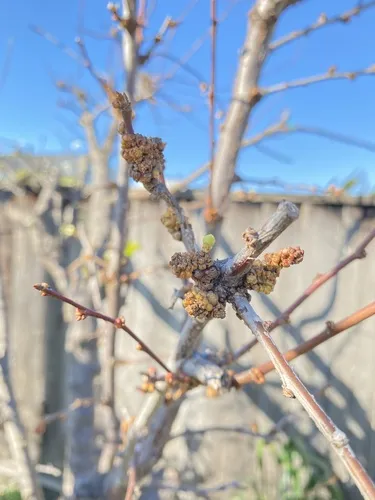
On almond the mite produces permanent irregular galls of various sizes around buds. It also deforms fruit spurs. The entire physiology of the attacked almond tree becomes upset: fruit buds fail to form, trees lose vigor, and damage appears to be progressive, and irreversible. This results in almond trees dying in 3 to 6 years. A physiological strain of almond grows in Lebanon which is immune to attack by A. phloeocoptes . On plum, small subspherical galls of between 1.3 and 1.8 mm in diameter grow around buds. These galls may be single, or grouped around the buds. The galls become woody, and deform fruit spurs. But in contrast to almond, plum trees often recover from mite attack and show no lasting injury. Kyle Beucke, the primary state entomologist for California, has the following advice: As we are currently trying to determine the distribution of this mite in California, I would advise anyone finding suspect plum bud gall mite galls to report them to their local county agricultural commissioner’s office. It is important that infestations of plum bud gall mites are promptly reported and that specimens are collected and identified by California Department of Food and Agriculture personnel. Galls with live mites should not be sent through the mail. Also, Jim Amrine , a specialist working on Eriophyoidea, is working more broadly to find all US locations where this mite has been found. Please notify him too of any suspected sightings.
Classification
- Kingdom
- Animalia
- Phylum
- Arthropoda
- Class
- Arachnida
- Order
- Trombidiformes
- Suborder
- Prostigmata
- Superfamily
- Eriophyoidea
- Family
- Eriophyidae (Gall mites)
- Genus
- Acalitus
Imported taxonomy record. Source availability varies; see the source references and editorial policy below.
Habitat and Range
Geographic Range
An invasive species in the US, "This species ranges extensively throughout southern and central Europe, and occurs in Asia minor. It has also appeared in the eastern United States." From an article in The Daily Garden , "As of January 2019, it made its way to California, threatening tens of thousands of plum, pluot, almond, apricot, and many other fruit and nut trees." Gall images from this infestation are posted . From a Powerpoint presentation about this species by Jim Amrine , Prof. Emeritus, West Va. Univ., "My distribution for this mite is: Algeria; Armenia [3499]; Austria?; Bulgaria; (Gansu) China [5562, 5162]; (Moldavia) Czech Republic; Croatia; Finland; France [6996]; Germany; Greece; Hungary; Italy; Israel [2213], Krasnodarskiy Region [3499]; Kyrgyz Republic; Lebanon [2213]; Moldavia [3499];Morroco [5062]; Portugal; Slovenia; Syria [2213]; Turkey [7701]; Ukraine [3499]; (California, Montana, Ohio [2777,2780], Washington) USA; [Yugoslavia]. We do not know who found it in CA, MT, or WA, or when; somehow, failed to document the distribution."
Additional species information
Species notes from the sources
Etymology: Acalitus phloeocoptes (Nalepa) 1890
About Mites: the wider group
Order-level background for Trombidiformes, the group containing Acalitus phloeocoptes. Species-specific details appear above.
Group overview
Trombidiformes includes ~26,000 described species of mites including velvet mites, chiggers, and spider mites. Spider mites (Tetranychidae) are among the most destructive agricultural pests worldwide.
Ecological role of the group
Velvet mites are important soil predators. Chigger larvae are parasitic on vertebrates and can cause intense itching (trombidiosis). Some mite species are used as biological control agents against pest mites in agriculture.
Economic and practical significance of the group
Spider mites cause billions of dollars in crop damage globally, affecting over 1,100 plant species. The two-spotted spider mite (Tetranychus urticae) has developed resistance to more pesticides than any other arthropod.
Recorded sources for this group: USDA, agricultural pest management research. Imported estimates may describe particular regions or reporting periods.
Photos of Almond and plum bud gall mite (2)
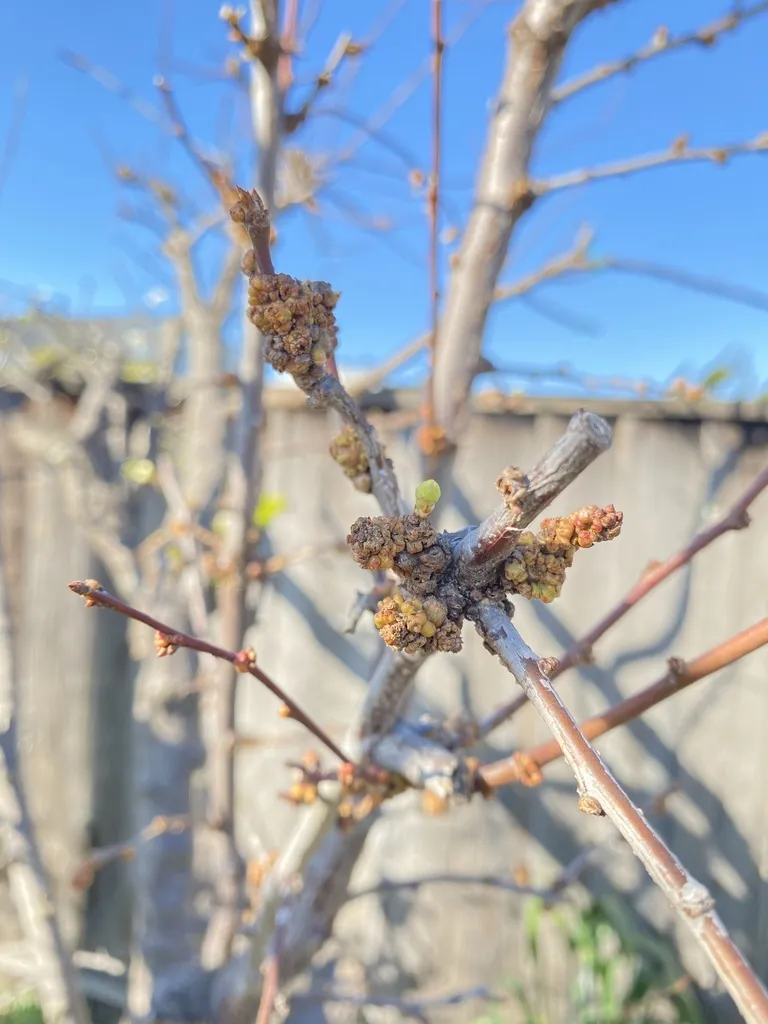
Photo credits: Contributed by Edward L. Ruden
Frequently Asked Questions About Almond and plum bud gall mite
What is Almond and plum bud gall mite?
Almond and plum bud gall mite (Acalitus phloeocoptes) is a species in the family Eriophyidae, within the order Trombidiformes.
How do you identify Almond and plum bud gall mite?
On almond the mite produces permanent irregular galls of various sizes around buds. It also deforms fruit spurs. The entire physiology of the attacked almond tree becomes upset: fruit buds fail to form, trees lose vigor, and damage appears to be progressive, and irreversible. This results in almond trees dying in 3 to 6 years. A physiological strain of almond grows in Lebanon which is immune to attack by A. phloeocoptes . On plum, small subspherical galls of between 1.3 and 1.8 mm in diameter grow around buds. These galls may be single, or grouped around the buds. The galls become woody, and deform fruit spurs. But in contrast to almond, plum trees often recover from mite attack and show no lasting injury.
Where is Almond and plum bud gall mite found?
Range: An invasive species in the US, This species ranges extensively throughout southern and central Europe, and occurs in Asia minor. It has also appeared in the eastern United States. From an article in The Daily Garden , As of January 2019, it made its way to California, threatening tens of thousands of plum, pluot, almond, apricot, and many other fruit and nut trees. Gall images from this infestation are posted . From a Powerpoint presentation about this species by Jim Amrine , Prof. Emeritus, West Va. Univ., My distribution for this mite is: Algeria; Armenia [3499]; Austria?; Bulgaria; (Gansu) China [5562, 5162]; (Moldavia) Czech Republic; Croatia; Finland; France [6996]; Germany; Greece; Hungary; Italy; Israel [2213], Krasnodarskiy Region [3499]; Kyrgyz Republic; Lebanon [2213]; Moldavia [3499];Morroco [5062]; Portugal; Slovenia; Syria [2213]; Turkey [7701]; Ukraine [3499]; (California, Montana, Ohio [2777,2780], Washington) USA; [Yugoslavia]. We do not know who found it in CA, MT, or WA, or when; somehow, failed to document the distribution.